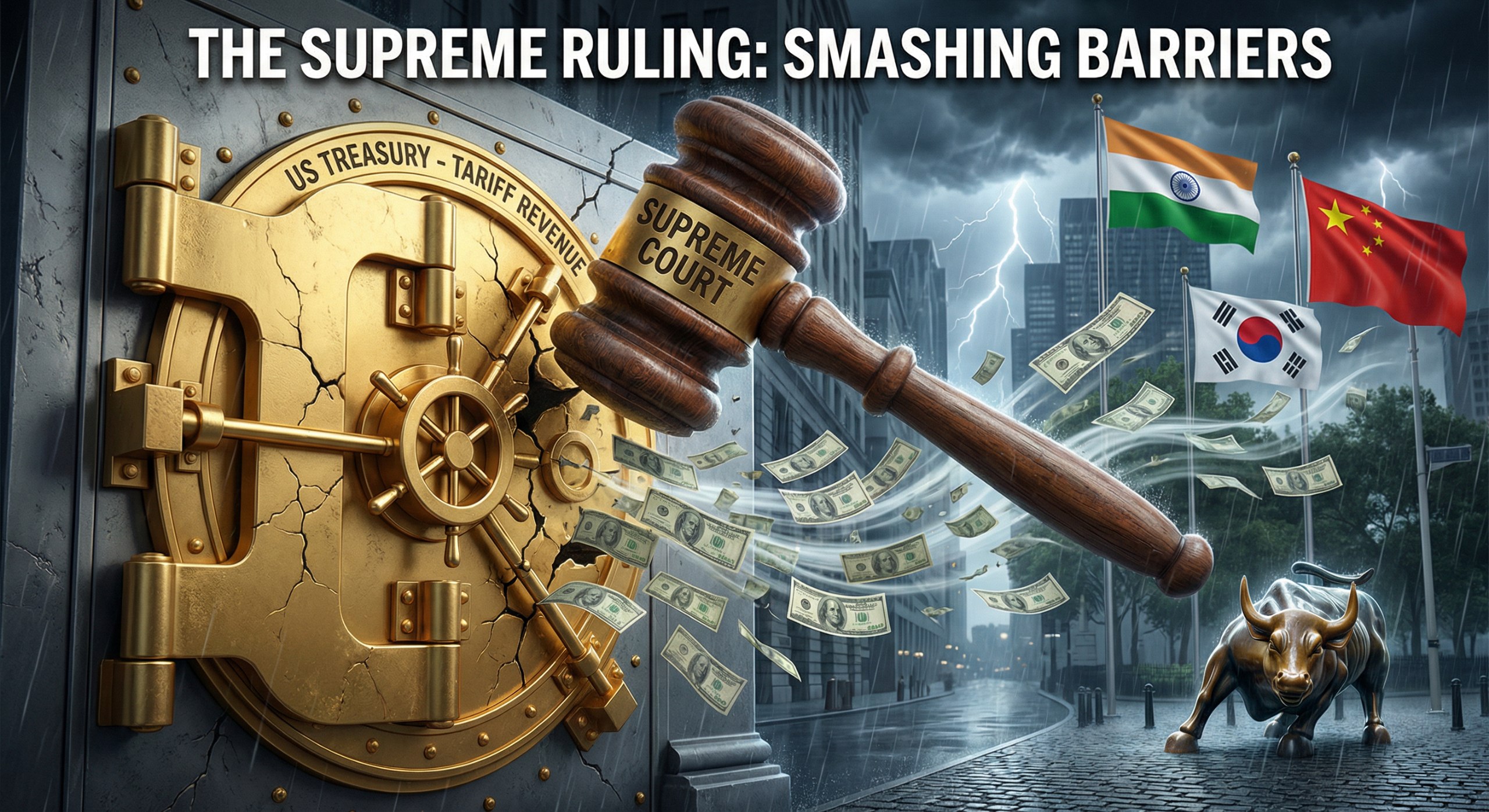
Washington DC: The US Supreme Court struck down the Trump administration’s global emergency tariffs on 6 February, holding in a 6-3 decision that the International Emergency Economic Powers Act (IEEPA) does not grant the president blanket authority to impose import duties without congressional approval. The ruling invalidates levies that had reached 50% on targeted countries and immediately clouds the legal status of past revenue collected—estimated by the White House at USD 900 billion.
The Geopolitical Reality
The judgement clips presidential trade prerogatives that have been expanding since 2017 and injects volatility into an already fragile global trading system. Countries that negotiated concessions in exchange for tariff relief now confront a double uncertainty: the duties may be re-imposed under a different statute, or the US Congress could reassert its constitutional control over tariffs, complicating future talks.
“The court has simply said IEEPA cannot be used for tariffs; it has not said tariffs themselves are unlawful.”
— Former US Supreme Court Justice
South Korea, Canada, Brazil and Vietnam—each of which signed limited agreements—face legal limbo. The EU and China, already in WTO disputes with Washington, gain tactical room to harden positions. Domestically, state governors are demanding that any tariff revenue collected “illegally” be refunded to American consumers, a transfer that would widen the federal deficit at a moment when sovereign debt is under market scrutiny.
The View from Delhi
India never signed a formal trade pact with the Trump administration; only a framework for an interim agreement was finalised on 13 February, with technical-level talks due 23-25 February. From New Delhi’s perspective, the court verdict therefore erodes US leverage before legal texts are locked in. Indian negotiators can now reopen terms that would have lowered US agricultural and medical-device tariffs in return for Washington’s removal of Section 232 duties on steel and aluminium.
More broadly, the ruling underscores the institutional risk of dealing with executive-centric trade regimes in the United States. Delhi has long preferred statutory, congressionally-ratified agreements for exactly this reason, but fast-shifting tariff politics may oblige India to keep future accords narrowly scoped and reviewable.
Strategic Implications
Three vectors merit watch:
- Re-imposition Pathways: The White House may invoke the Trade Act of 1974 (Section 122) or the National Emergencies Act to re-launch duties framed as responses to “reciprocal” or security threats. Each statute carries procedural delays and higher judicial scrutiny, but no clause outright bars tariffs.
- Congressional Re-engagement: A bipartisan bill restoring Capitol Hill’s tariff prerogative would bind future presidents, yet Capitol politics could keep any such bill stalled until after mid-term elections, leaving partners guessing.
- Market Signalling: Global supply-chain managers must price a US policy premium: the probability that tariff policy oscillates with court rulings and electoral cycles. India’s export sectors—pharma, textiles, engineering goods—face a narrower US margin buffer, complicating capacity planning.
For Indian diplomacy, the episode re-validates the value of multi-layered trade portfolios: deepening East Asian and EU links while engaging Washington issue-by-issue. It also reinforces the imperative to keep tariff negotiations technically, not politically, framed so that domestic courts or an unpredictable Congress cannot easily unravel them.