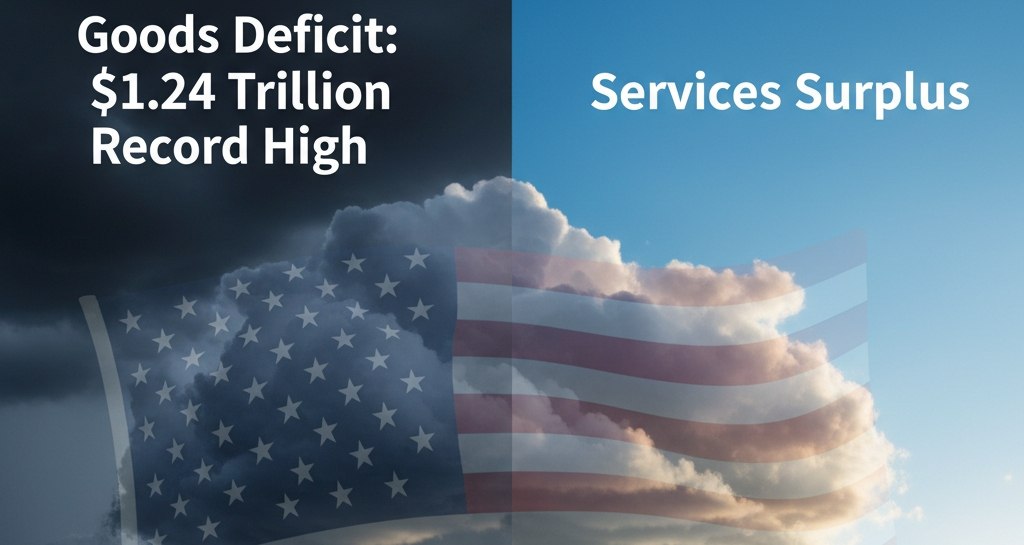
Washington: The United States merchandise trade deficit climbed to a record $1.24 trillion in 2025, the Commerce Department disclosed this week, while the combined goods-and-services shortfall stayed flat at $901 billion. The data confirm that steep tariffs imposed since January—up to 50% on Indian items and comparable rates on most major suppliers—have shifted import sources but have not cut the overall deficit.
The Geopolitical Reality
President Trump’s second-term trade policy rests on a single metric: narrowing the import-export gap by coercion. After 15 months, the numbers show a 32% contraction in the bilateral deficit with China, matched by 44% growth in the gap with Vietnam and near-doubling with Taiwan as electronics assembly lines moved. Mexico has also emerged as the largest single exporter to the U.S., replacing China in value terms but not in volume of American demand.
The outcome is textbook trade diversion: tariff walls redirect containers, not consumption. Global exports to the U.S. rose 5% in value last year while American overseas sales added only 6%, leaving the structural imbalance intact. Because the dollar remains the primary settlement currency, the external liabilities of the United States—held increasingly by Asian central banks—continue to expand.
"Tariffs are a blunt scalpel; they reroute trade, they do not eliminate it."
— Gene Grossman, Princeton Trade Economist
Macro-economically, the deficit is also a mirror of domestic savings shortfalls. With Congress approving fresh tax reductions and the Federal Reserve holding rates above neutral, Washington sucks in foreign capital, automatically widening the current-account gap no matter where goods are sourced.
The View from Delhi
For India, the headline figure is mixed. Tariff escalation on labour-intensive exports such as textiles and engineered products has already depressed shipments to the U.S. by roughly 7% year-on-year. Yet the same protectionist wave has opened marginal space for Indian generic pharmaceuticals, chemicals and speciality steel in American supply chains that previously relied on China. New Delhi’s strategists will weigh whether to press for a limited trade pact—similar to Tokyo’s 2019 deal—or to absorb the duties as the cost of demonstrating strategic autonomy.
More importantly, the episode demonstrates the limits of tariff diplomacy in an economy where services surpluses are thin. India runs a $37 billion monthly goods deficit of its own; watching Washington fail to shrink a deficit twenty-five times larger offers a live case study in the constraints facing import-substitution policies.
Strategic Implications
- Export Re-alignment: Expect Vietnam, Indonesia and Mexico to entrench as tariff-safe hubs; Indian firms may integrate with them rather than fight market access alone.
- Investment Flows: U.S. multinationals seeking "China-plus-one" will diversify, but final assembly could bypass India if duty-free access is unavailable.
- WTO Friction: A dispute on the Most-Favoured-Nation clause is likely; India could gain legal cover should it decide to retaliate.
- Currency Management: A strong dollar policy keeps emerging-market central banks, including the RBI, accumulating U.S. treasuries—limiting room for autonomous rate cuts.
Finally, the episode underlines a structural truth: in a world of integrated supply chains, punitive duties mostly raise costs for domestic consumers while redistributing market share among exporters. For New Delhi, the strategic takeaway is not moral but material—leverage exists only where alternatives do not.