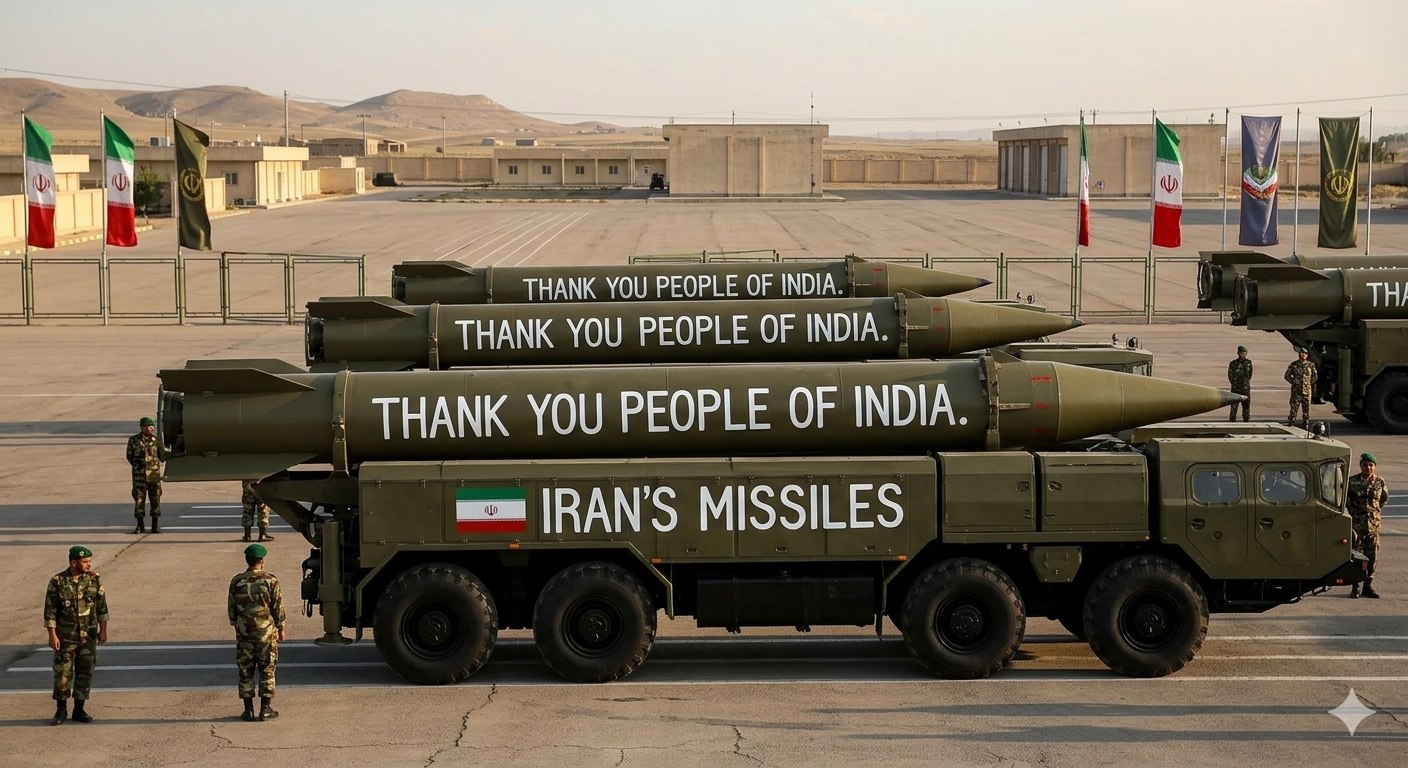
Tehran: Iranian propaganda units have released footage of surface-to-surface missiles being fired toward Israel with the phrase “Thank You People of India” stencilled on the fuselage. The clips, circulated during what Tehran calls its 83rd “wave” of strikes, also thank Germany, Spain and Pakistan, listing them as countries that have not joined U.S.-led military action against Iran.
The Geopolitical Reality
The messaging is part of a narrative warfare campaign designed to magnify the appearance of international support. None of the named states has endorsed the strikes; India, Germany and Spain have publicly called for de-escalation, while Islamabad has merely kept its 2021-era Saudi deployment dormant.
“Painting country names on munitions is theatre, not diplomacy.”
— Western defence official
Tehran’s broader objective is to drive U.S. forces out of the Gulf. Iranian spokesmen claim 13 American bases in Kuwait, Qatar and Saudi Arabia are now “uninhabitable” after repeated missile and drone assaults, forcing partial troop withdrawals. Washington has not confirmed casualty numbers or facility closures.
The View from Delhi
India’s strategic neutrality in the Iran–Israel confrontation leaves little incentive to respond to graffiti on enemy weapons. Delhi’s priority is energy flow and seven-million-strong diaspora safety, not public-relations skirmishes. Yet the incident highlights how easily India’s balanced posture can be weaponised by others: Tehran amplifies Indian humanitarian gestures—rescuing two Iranian merchant vessels last December, offering condolences on the Supreme Leader’s death—to craft a storyline of implicit alignment.
Strategic Implications
- Reputation Risk: Repeated association with Iranian strikes, however false, complicates Delhi’s outreach to Abraham-accord Arab states and could feed Israeli scepticism during critical defence technology talks.
- Diaspora Security: Any perceived Indian tilt risks retaliatory messaging from opposing camps, endangering workers in the GCC who remit USD 110 billion yearly.
- Information Space: Expect more open-source manipulation as regional actors weaponise gratitude lists, boycott calls and fake endorsements to widen the diplomatic cost for fence-sitters.
Delhi’s response toolkit is limited: private démarches in Tehran, quiet coordination with Gulf intelligence, and accelerated economic engagement with both Riyadh and Tel Aviv to underscore transactional multipolarity. The episode is a reminder that in saturated media environments, neutrality itself becomes leverageable—and must be defended as actively as any treaty alliance.