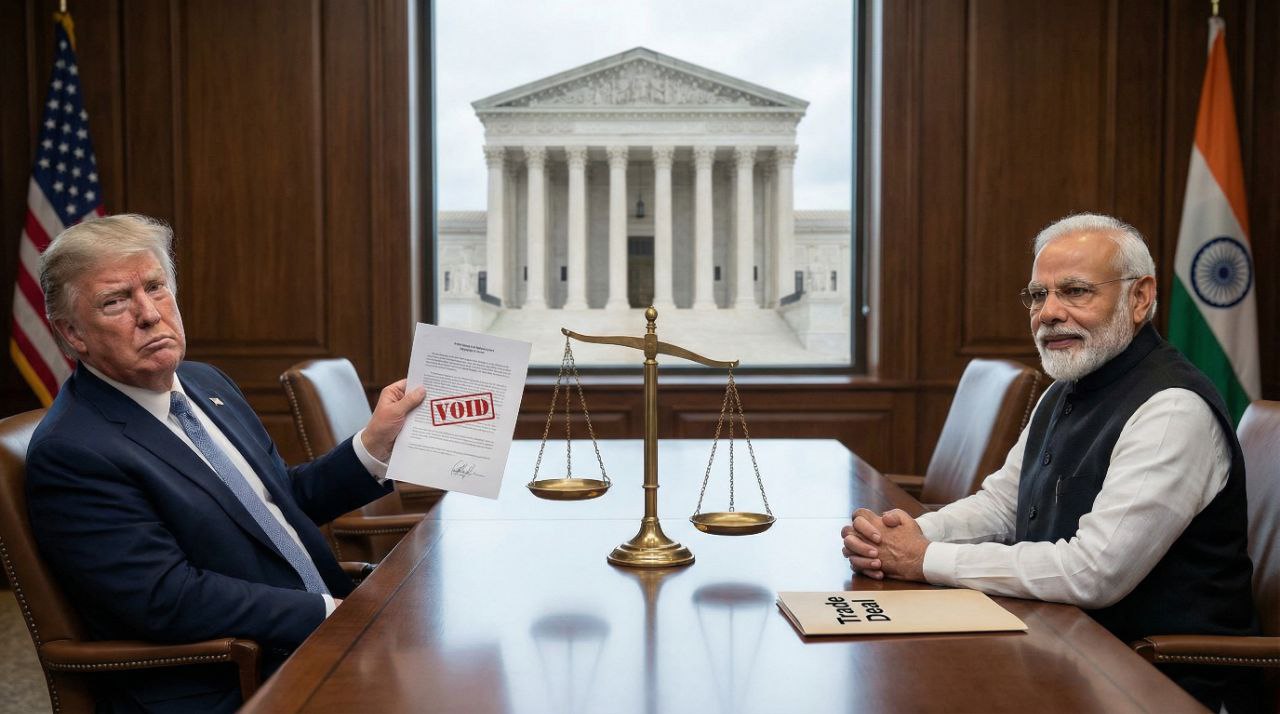
Washington: U.S. President Donald Trump, reacting to a Supreme Court decision that invalidated earlier punitive duties, has signed an executive order imposing a uniform 10% tariff on virtually every trading partner. The measure, effective 24 February and slated to run for 150 days, collapses previously negotiated rates that had placed India at 18%, the EU and Japan at 15%, and Vietnam at 20%.
The Geopolitical Reality
The uniform 10% levy compresses the tariff ladder that Washington had used to reward allies and punish strategic competitors. By resetting all rates to a single figure, the White House removes a bargaining chip that had underpinned bilateral trade deals since 2017.
Key economies now face a common external tariff:
- European Union: Falls from 15% to 10%.
- Japan: Falls from 15% to 10%.
- South Korea: Falls from 15% to 10%.
- Vietnam: Falls from 20% to 10%—the steepest reduction.
- India: Falls from 18% to 10%.
The Court found that the earlier country-specific duties exceeded presidential authority under existing trade laws, forcing the administration to search for a statutory route that applies equally to all WTO members.
"All of those agreements are now reset to 10% under this new tariff rate once it goes through."
— White House official, quoted by U.S. journalists
The View from Delhi
New Delhi enters the next round of trade talks with the effective U.S. tariff on Indian goods already reduced without conceding additional market access. The narrowing differential erodes—but does not eliminate—the price advantage Vietnam and Bangladesh previously enjoyed in labour-intensive sectors such as textiles and leather.
Indian negotiators now confront two constraints:
- Shrinking leverage: The 10% ceiling caps the potential upside Washington can offer in exchange for Indian concessions on agriculture, medical devices, or data-localisation rules.
- Time-bound uncertainty: The 150-day window compresses decision-making; any interim agreement must be future-proofed against a possible Congressional overhaul of U.S. tariff authorities.
Yet the playing field has levelled in India’s favour relative to competitors that had secured lower pre-existing rates. The effective reduction could support export volumes in chemicals, engineering goods, and jewellery where India competes head-to-head with Thailand and Mexico.
Strategic Implications
First, a tariff vacuum now exists: if the administration fails to pass new enabling legislation before the 150-day mark, rates could either snap back to MFN levels or become a bargaining chip in the next electoral cycle. Indian exporters must therefore treat the current advantage as provisional.
Second, the episode exposes the fragility of executive-branch trade policy in the United States. New Delhi must weigh the reliability of any commitments that are not embedded in statute or covered by WTO bindings.
Third, Vietnam’s larger reduction (20%→10%) keeps its cost advantage intact in garments and electronics assembly. India’s margin gains are real but modest; without productivity gains or logistics savings, market-share shifts may remain marginal.
Finally, the Court’s rebuke intensifies partisan scrutiny of presidential trade powers. A future U.S. Congress could claw back authority, making any quick, high-profile bilateral deal politically radioactive. For India, the optimal path is incremental, sector-specific agreements that lock in duties on items where India already holds comparative advantage—pharmaceuticals, automotive components, and niche textiles—while deferring flash-point issues such as dairy and e-commerce rules until a clearer legislative framework emerges.