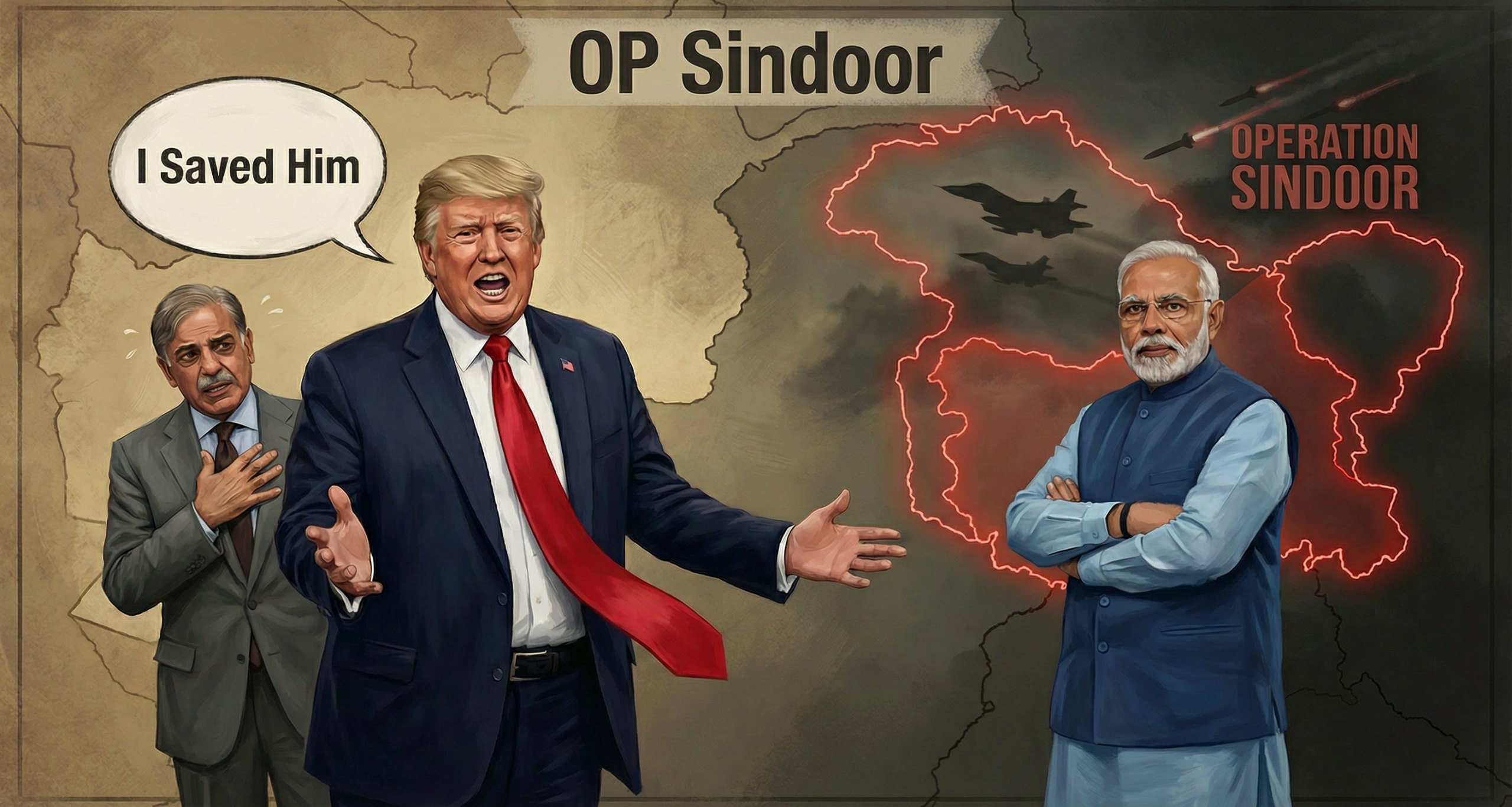
Washington: Donald Trump told a joint session of the US Congress that India and Pakistan were “going to nuclear” and that 35 million people, including Pakistan’s Prime Minister Shehbaz Sharif, would have died had he not intervened. The remark, delivered during what aides billed as a policy speech on 25 February, was not accompanied by de-classified evidence or corroboration from either South-Asian capital.
The Geopolitical Reality
Nuclear signalling between India and Pakistan has historically been managed through back-channel diplomacy and third-party reassurance, not public declarations. Trump’s claim inserts a domestic US narrative into a deterrence relationship both capitals prefer to keep opaque.
Pakistan’s silence is analytically significant. Islamabad has issued no rebuttal or confirmation, leaving open whether Sharif’s government fears jeopardising future US assistance or simply judges any response counter-productive.
US internal calculus: With approval ratings below 40 % and mid-term elections nine months away, Trump is re-casting foreign-policy setbacks—Ukraine stalemate, tariff-driven inflation, H-1B disruption—into personalised rescue stories that require no legislative votes.
The View from Delhi
New Delhi neither confirms nor denies third-party mediation in crisis moments, but it has systematically opposed any suggestion that its deterrent posture is negotiable overseas. Indian strategists will read Trump’s statement as:
- Reputation risk: A public US claim diminishes India’s narrative of autonomous crisis management.
- Operational signal: Washington may feel incentivised to keep the sub-continent on a short diplomatic leash, complicating future Indian conventional responses to terror attacks.
- Pakistani leverage: Islamabad could interpret American self-congratulation as implicit protection, reducing the cost of its own brinkmanship.
Delhi’s short-term response is therefore likely to be silence, coupled with accelerated back-channel assurances to both Washington and Islamabad that India’s red-lines remain domestically defined.
Strategic Implications
Arms-control vacuum: With New START already in limbo, Trump’s narrative raises the probability that future US administrations will treat South-Asian stability as a personalised presidential achievement rather than a rules-based outcome. This weakens multilateral pressure for India–Pakistan risk-reduction agreements.
Domestic blow-back: If mid-term losses erode Trump’s authority, a successor could distance Washington from the claim, forcing India to recalibrate deterrence signalling without clarity on when or whether US emergency diplomacy might re-engage.
Chinese calculation: Beijing, tracking US speeches for evidence of distracted commitments, could judge the Taiwan contingency window as widening if Washington is publicly self-occupied with sub-continental nuclear hypotheticals.
“The episode underscores how quickly great-power politics can instrumentalise South-Asian stability for domestic US consumption.”
— WFI Assessment