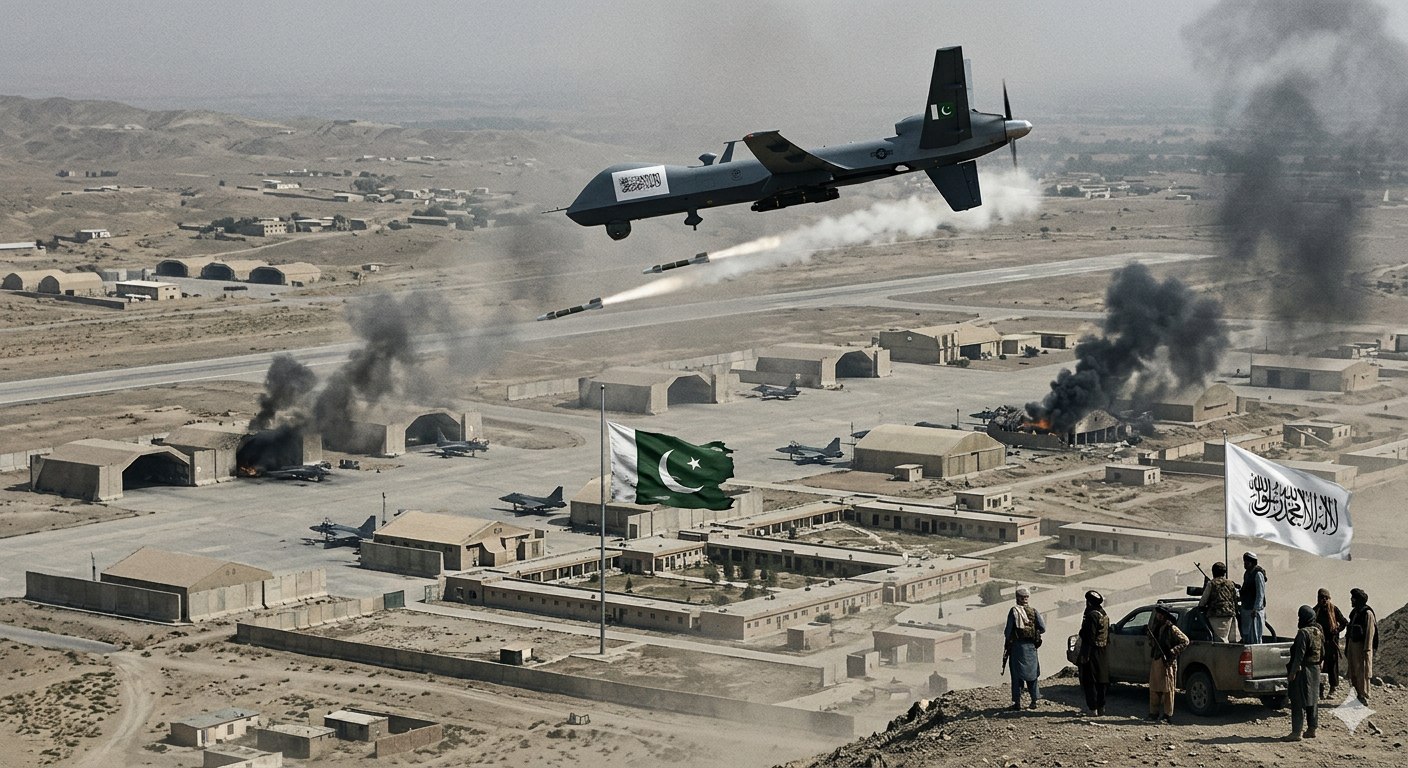
Kabul/Islamabad: Taliban defence authorities released video on 29 November asserting multiple drone strikes against Pakistani military installations, including the sensitive Nur Khan base outside Islamabad. Afghanistan’s Ministry of National Defence tweeted that its air force conducted “precise and co-ordinated aerial operations” in retaliation for repeated Pakistani airspace violations. Islamabad has so far denied any damage or loss of life.
The Geopolitical Reality
The strikes—if verified—highlight three structural weaknesses: Pakistan’s Chinese-supplied HQ-9 air-defence batteries have not intercepted low-slow-small drones; the Pakistan Air Force is politically constrained from retaliating inside Afghanistan; and the Taliban are using low-cost quadcopters to impose reputational costs on a nuclear-armed neighbour.
“When a $2,000 quadcopter can reach a nuclear-armed state’s key base, deterrence is up for re-negotiation.”
— Independent Asia-Pacific security analyst
Islamabad’s dependence on HQ-9/P and FD-2000 systems, bought after Turkey declined to supply the T-LORAMIDS, now faces empirical scrutiny. Chinese state media has stayed silent; Russian sources privately note that Beijing itself relies on S-400 rings around core cities, not HQ-9, for point defence.
The View from Delhi
New Delhi’s public posture is watchful silence. Indian planners see three immediate take-aways:
- Technical: Drone saturation can bypass tiered, but untested, Chinese air-defence architectures.
- Diplomatic: A second successive embarrassment for Pakistan (after Balakot 2019) weakens its escalation narrative.
- Force-planning: Islamabad may now request additional FD-2000 batteries; China could offer them at “friendship prices”, deepening Pakistan’s single-vendor risk.
The episode also vindicates India’s parallel pursuit of layered counter-drone grids— indigenous D4 systems, Israeli SMASH-2000 rifles, and Russian S-400—rather than relying on one imported platform.
Strategic Implications
Expect three downstream effects:
- Pakistan Army internal audit on air-base hardening and passive defence; resources diverted from the Indian border.
- Beijing’s export pitch for HQ-9 variants will face customer scepticism in the Middle East and South-East Asia.
- Taliban leverage in back-channel talks—Islamabad may have to concede border-fence dismantlement or prisoner swaps to avoid further drone harassment.
For India, the safest course is sustained capability accretion while letting the western neighbour manage its own blowback. Delhi gains time, not victory.