MOSCOW/NEW DELHI: Russia has formally ended the monthly release of data detailing crude oil and refined product exports by destination, according to a 9 March transcript of a widely-followed Hindi-language current-affairs broadcast that cited the Centre for Research on Energy and Clean Air. Officials in Moscow framed the move as a bid to halt what they termed a "circus" of political commentary around sales to India, China and other buyers.
The Geopolitical Reality
Moscow's opacity arrives as Washington signals it may un-sanction Russian crude if Middle-East tensions push Brent past $100/bbl. The Kremlin calculates that hiding volume and pricing details blunts U.S. leverage: without hard numbers, Congressional hawks cannot argue that India or others are undermining sanctions. Simultaneously, Iran's military has publicly warned it could drive oil to $200/bbl by attacking Gulf infrastructure if regime-change operations escalate—an outcome that would erase Russia's need to offer discounts.
- Discount erosion: Urals differentials versus Brent have narrowed from $20-25/bbl in 2022 to an estimated $6-8/bbl in early 2025.
- Market share: India imported ≈1.55 mb/d of Russian crude in January 2025, second only to China across Moscow's customer list.
- Data blackout: Country-wise export tables, previously released by Rosstat and Argus, will no longer be published; only aggregate export volumes will appear.
"Russia will not disclose data on its crude oil export to India."
— Russian government statement
Washington's recent U-turn—first issuing a 30-day waiver for Indian purchases, then mulling full sanctions removal—indicates an attempt to pre-empt a supply shock if Iranian threats materialise. Yet the absence of public Russian data makes it harder for traders to assess true availability, feeding volatility.
The View from Delhi
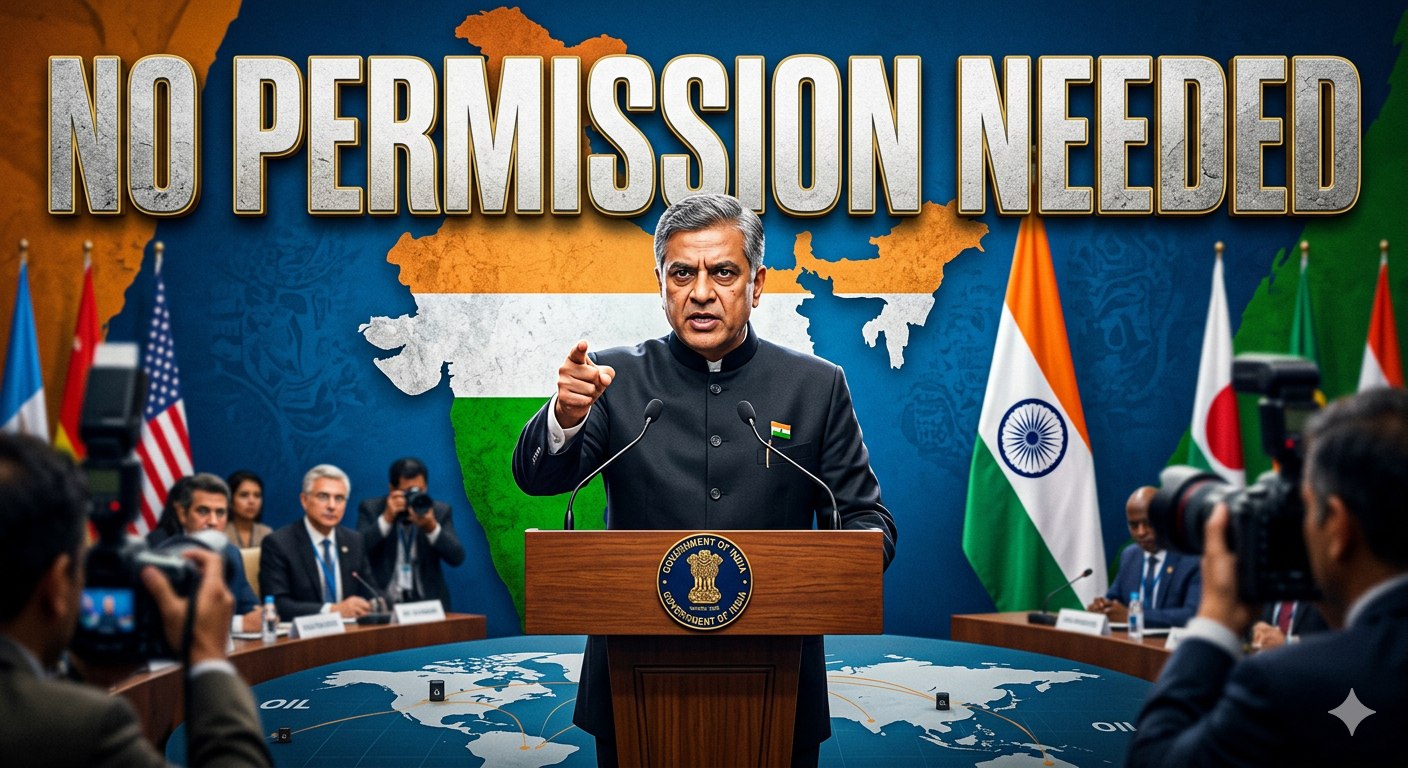
For Indian procurement planners, the Kremlin's data blackout complicates three operational variables: benchmarking attainable discounts, proving compliance with G-7 price-cap rules to European insurers, and estimating freight differentials versus Atlantic Basin alternatives. With the Petroleum Ministry already stating it "does not need permission from any country" to buy Russian oil, the issue is no longer diplomatic but technocratic—how to negotiate without transparent price discovery.
Loss of discounts directly inflates the import bill. Every $1/bbl increase across 1.5 mb/d adds roughly $550 million annually; if Urals discounts disappear entirely, the incremental cost approaches $4 billion—about 0.12% of GDP, transmitted via higher current-account deficit and rupee pressure.
Diversification options are narrowing. Saudi official prices for Asia have tracked Brent at a premium, while U.S. Gulf sour grades face longer voyages and require trimming of high-sulphur residue, a capability only four Indian refineries currently possess. Iraq's Basrah Heavy offers volume but remains vulnerable to Iranian disruption through the Basra loading berths.
Strategic Implications
Near-term, India must negotiate annual term contracts with Rosneft and Gazprom Neft without the safety of monthly spot-price windows. Refiners will shift more volume to Dubai-linked formulas, accepting opaque retroactive adjustments—a model that favours sellers.
Medium-term, opaque pricing weakens India's bargaining power with Middle-East producers. If Iranian strikes materialise and prices spike to $150-200/bbl, Moscow gains cartel-like leverage: it can quietly redirect Urals east without revealing premia, forcing India to accept whatever terms avoid physical shortage.
Policy choices centre on three levers: (1) accelerate talks for a rupee-payment mechanism that bypasses G-7 insurance and therefore the price cap, (2) expand strategic petroleum reserves to 90 days cover by 2026 to ride out 3-4 month disruptions, and (3) use the loss of discounts as political cover to resume Iranian imports if sanctions are relaxed—an option Delhi has kept structurally open by maintaining the Iran clearing account in UCO Bank.
The opacity works both ways: Russia cannot credibly threaten to divert volumes west if India negotiates hard, because no public data would validate such a threat. Delhi's optimal strategy is to keep purchases flat, refuse retroactive premiums, and let China absorb any price spike first—knowing Beijing's buying surge would quickly reveal itself through customs leakage, restoring a reference price.