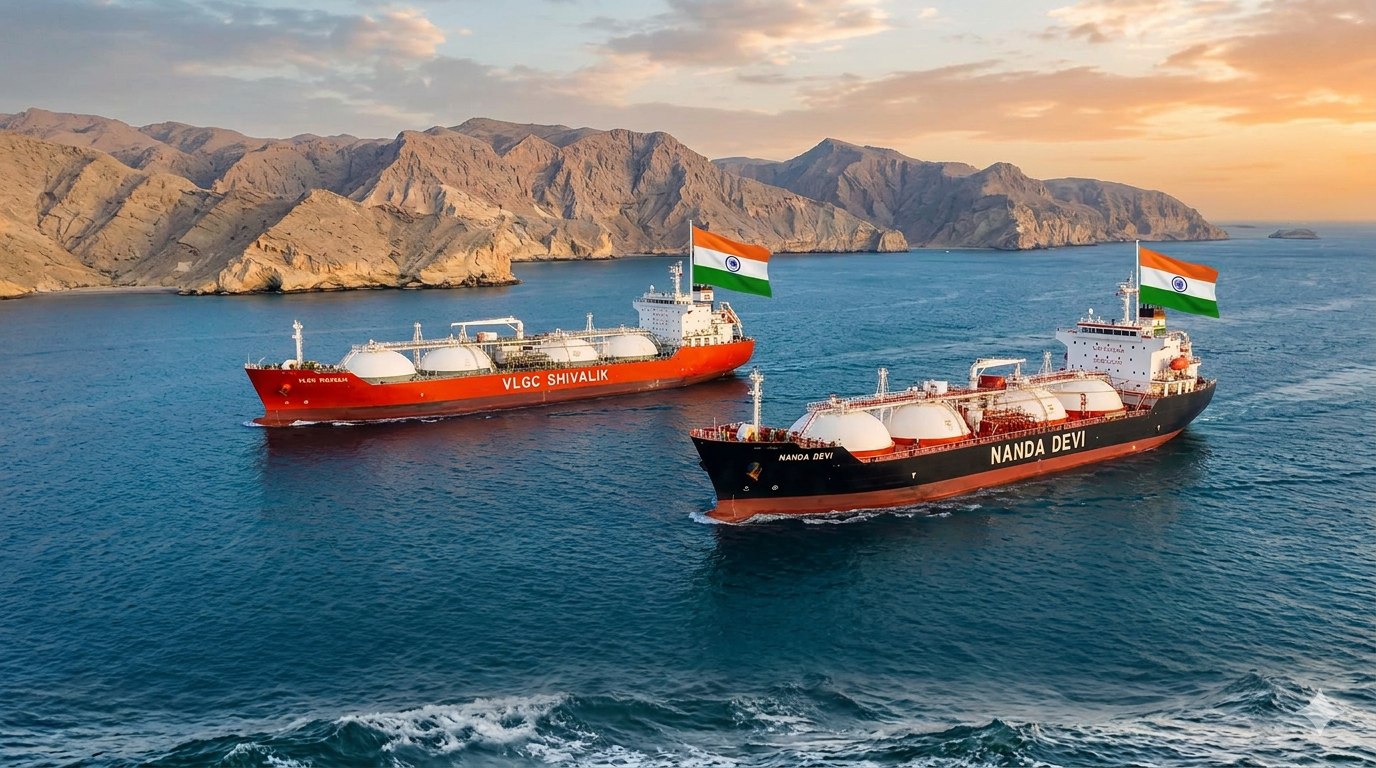
New Delhi: Iran has authorised two Indian liquefied-petroleum-gas carriers to transit the Strait of Hormuz, according to a 13 April statement by Iran’s ambassador to India, Mohammad Faghfouri. The move follows weeks of military tension that closed the choke-point and choked off India’s main LPG supply line from Qatar.
- Two tankers: Indian-flagged, carrying a combined 90,000 t of LPG.
- Passage window: Opened 12 April, valid for “immediate transit”, ambassador said.
- Origin: Loaded at Ras Laffan, Qatar; destination west-coast Indian ports.
“Indian vessels will receive safe passage very soon because of our special relationship with India.”
— Mohammad Faghfouri, Iranian Ambassador to India
The ships are expected to reach Indian terminals in 10–12 days. Local distributors warn the volume covers barely two days of national consumption, leaving LPG cylinder shortages that have pushed black-market prices to ₹2,000 in Uttar Pradesh and Maharashtra largely unchanged.
The Geopolitical Reality
The United States–Iran confrontation has turned the 21-nm strait into a contested battlespace. Washington’s post-6 April air campaign aimed to disable Iranian naval assets; Tehran responded by mining sea-lanes and warning insurers against covering “hostile-flag” tankers. Qatar, which supplies roughly 45 % of India’s annual 18 mt LPG imports, temporarily suspended loadings.
China secured priority Qatari cargoes in March via long-term contracts and owns three storage caverns on its eastern seaboard; Japan and South Korea drew on 3–4 month stockpiles. India lacks comparable strategic storage for LPG, forcing dependence on spot arrivals.
With Hormuz partially reopened only for “friendly” flags, Washington is now quietly asking Delhi to accelerate purchases of Russian crude to stabilise global oil prices—an ask that underscores the energy leverage Washington has ceded to Moscow and Beijing.
The View from Delhi
New Delhi’s immediate problem is less volume than timing. Indian refiners hold 19 days of crude oil in underground caverns; LPG buffers at refineries equal barely seven days of cooking demand. Building pressurised refrigerated storage would cost an estimated US $3–4 billion and require 4–5 years—capital and calendar that the election cycle has never prioritised.
Politically, the government cannot be seen favouring any side in the US–Iran fight; strategically, it cannot allow a single maritime choke-point to threaten food-fuel logistics for 300 million domestic LPG consumers. The episode therefore revives the dormant proposal for a government-backed LPG reserve financed on a PPP model, though fiscal space remains tight.
Strategic Implications
Even if Hormuz reopens fully, three structural risks persist: (1) India’s import basket is 70 % concentrated in two suppliers—Qatar and Saudi Arabia; (2) LPG is excluded from the 2020-built crude strategic reserve architecture; (3) spot price spikes transmit instantly to voters, unlike diesel or kerosene which have buffer stocks.
Long-term mitigation points toward diversification—Nigeria, the US Gulf, and Mozambique Rovuma LNG—but these routes circle the Cape and raise freight 25 %. The cheaper insurance is domestic: accelerating piped-natural-gas connections and induction cook-stove subsidies to cut cylinder demand 15 % over five years.
Until then, every US–Iran escalation will keep Indian kitchens hostage to the world’s most sensitive oil artery.