
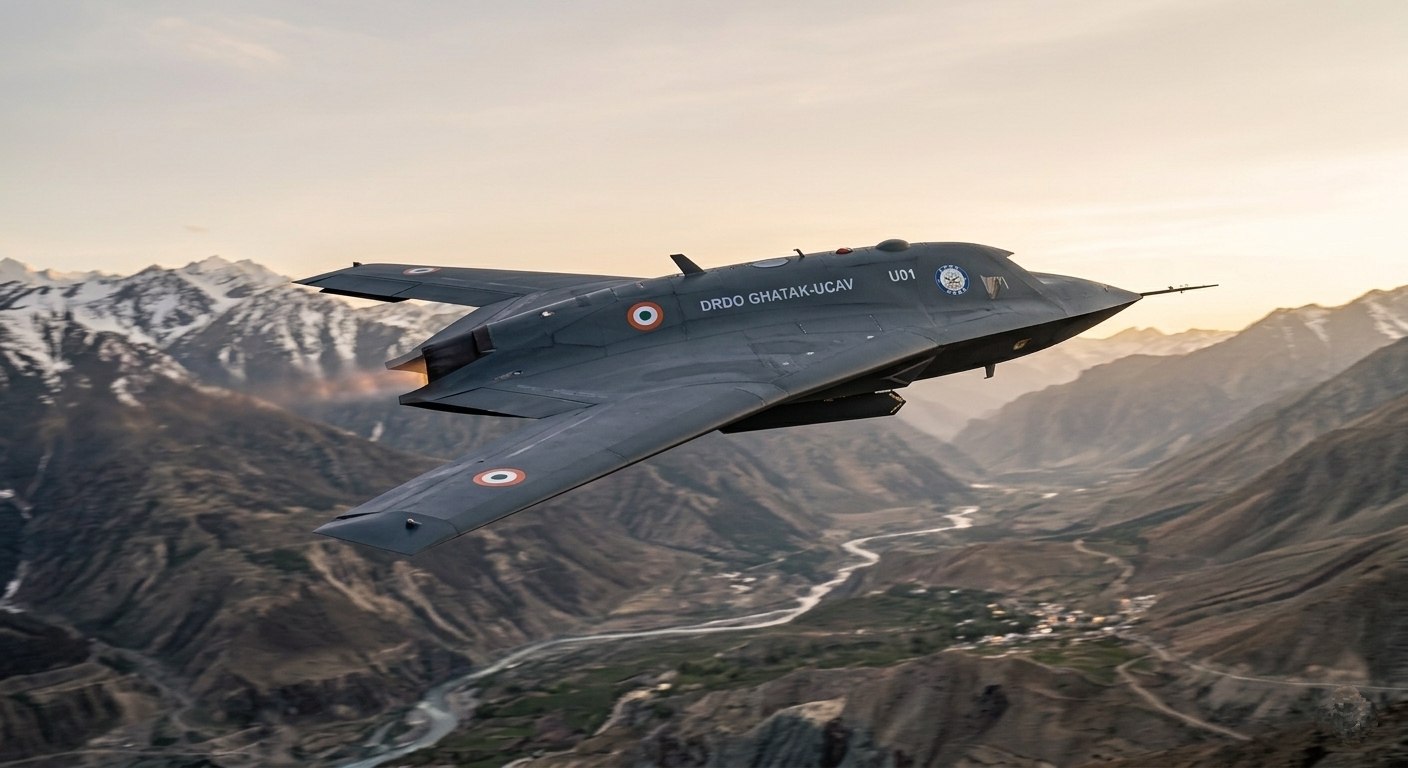
BENGALURU: The Defence Research and Development Organisation (DRDO) is fabricating a flying-wing unmanned combat air vehicle—the Ghatak UCAV—using 80–90 % carbon-prepreg composites to achieve a low-observable signature for deep-strike missions inside heavily defended airspace.
The Geopolitical Reality
Major powers have fielded layered integrated air-defence systems that push conventional fighters into high-risk standoff ranges. The response has been a global shift toward stealth drones that combine reduced radar cross-section with autonomous targeting, lowering both political and human cost of penetrating strikes.
- US B-21 Raider: Scheduled for production with open-architecture data links.
- Russia Okhotnik-B: Flying-wing UCAV flight-tested alongside Su-57.
- China GJ-11: Rumoured internal bay capacity of two tonnes.
These platforms are increasingly co-developing loyal-wingman ecosystems, fusing stealth, autonomy and AI-driven target designation to suppress or destroy enemy air defences on the first day of war.
"Once operational, a stealth UCAV gives a middle power the ability to hold strategic targets at risk without forward-basing crewed aircraft."
— Air Commodore (Retd.)
The View from Delhi
New Delhi calculates that a credible deep-strike drone reduces deterrence instability along two vectors: it complicates Pakistani air-defence planning for counter-force operations, and it dilutes the PLA’s confidence in the survivability of Tibetan airfields and missile sites during a Himalayan contingency.
Indigenous propulsion—derived from the Kaveri programme—also limits future veto power by foreign engine suppliers, a constraint Delhi faced on previous combat-aircraft projects. The carbon-composite airframe choice signals parallel efforts to seed domestic capacity in advanced materials, useful across civil aviation and satellite buses.
Integration challenges remain: bandwidth-resilient data links for beyond-line-of-sight control, AI robust enough to operate inside contested electro-magnetic spectrum, and doctrinal clarity on autonomous lethal decision below the nuclear threshold.
Strategic Implications
A deployable Ghatak squadron would expand India’s escalation menu: precision strikes on terrorist infrastructure or command nodes could be executed under a lower attribution signature, reducing immediate pressure for conventional retaliation.
Yet the same attribute raises escalation-risk questions for adversaries lacking satellite-based launch detection, potentially shortening their decision windows for theatre-nuclear response. Delhi will need to weigh whether the perceived deterrent benefit outweighs the risk of an adversary pre-empting an ambiguous UCAV ingress.
Finally, success of Ghatak sets a precedent for export-controlled technology denial: proving domestic competence in stealth shaping, composites and engine control software weakens future technology-control regimes targeted at India’s high-tech sector.