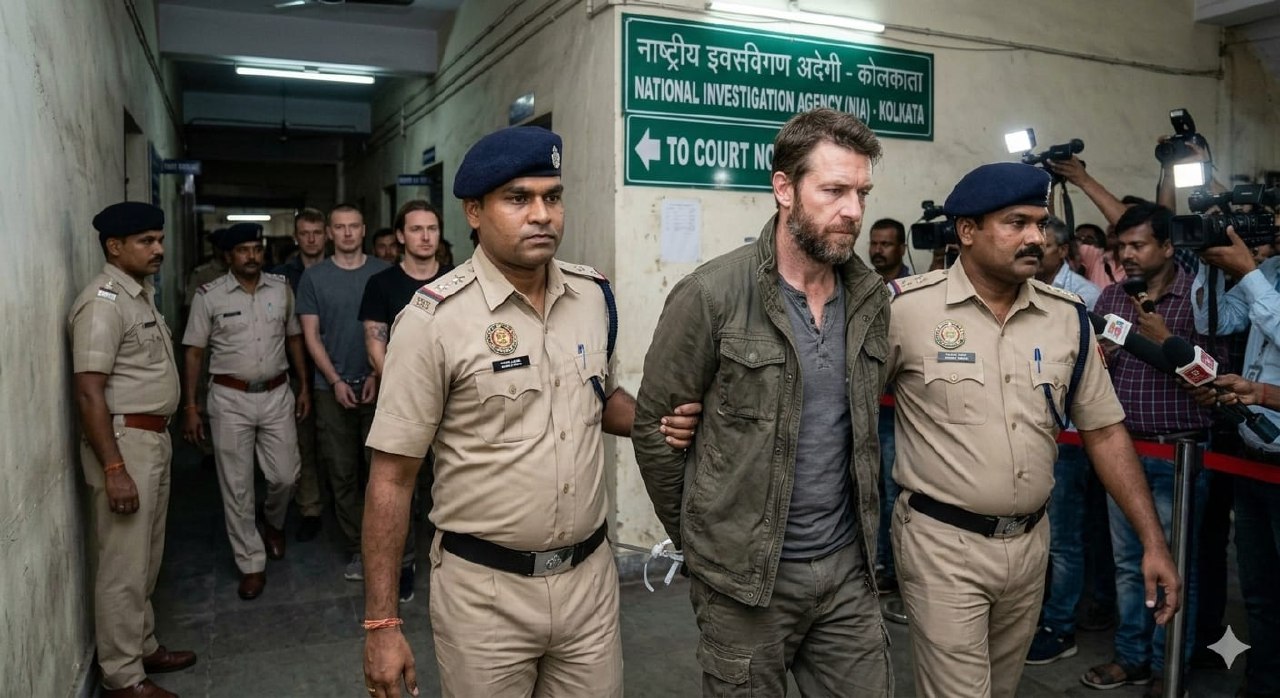
New Delhi: The National Investigation Agency (NIA) has arrested seven foreign nationals—six Ukrainians and one U.S. citizen—after they crossed illegally into Myanmar from Mizoram. The group allegedly planned to instruct anti-junta forces in drone and loitering-munition tactics.
All seven entered India on tourist visas, travelled to Guwahati, reached Mizoram without restricted-area permits, and slipped across the border in early May. Their interception, confirmed by court filings in Patiala House, is the first publicly acknowledged case of Western freelancers attempting to use Indian soil as a logistical springboard into Myanmar’s civil war.
The Geopolitical Reality
Myanmar’s 2021 military coup pushed the country into a protracted, fragmented insurgency. Ethnic armed organisations—many operating along the 1,600-km frontier with India—have gradually acquired commercial drones for reconnaissance and light attack roles. External actors now see value in accelerating that trend.
- China: Supplies the ruling State Administration Council with air-defence systems and diplomatic cover at the UN.
- United States: Imposed successive sanctions but lacks a border; covert action options are limited.
- Thailand: Tightened border controls, pushing third-country routes northward.
- India: Shares a porous, jungle-covered frontier and maintains a “Act East” transit corridor through Mizoram’s Zochachhuah post.
Washington’s official position remains supportive of Myanmar’s ousted civilian government. Yet no public authorisation links the detained American, Matthew VanDyke, to U.S. agencies. VanDyke has previously fought in Libya and Syria, directed a medical-aid NGO in Ukraine, and on social media advertises himself as leader of Sons of Liberty International, a self-styled private expeditionary group.
“To the leaders of Burma, Iran and other authoritarian regimes: we are coming for you… Russia will not be able to save you.”
— Matthew VanDyke, Twitter, January 2025
The View from Delhi
For Indian planners, the episode spotlights three structural risks:
1. Border Management: The Free Movement Regime allows tribes straddling the Indo-Myanmar border to travel 16 km without documents. Delhi has announced plans to fence the boundary; implementation is uneven. Any perception that India offers a path of least resistance to arms instructors invites replication.
2. Refugee Spill-over: Mizoram already hosts 40,000 Chin refugees. Escalation of external support to anti-junta militias could provoke Tatmadaw retaliation, pushing a new wave into India’s north-east and complicating citizenship and security vetting.
3. Great-Power Friction: Quiet U.S. frustration with India’s neutral posture on Ukraine is well documented. An extended trial of an American national—however unofficial—adds a bilateral irritant just as Delhi seeks critical-technology waivers from Washington.
India’s legal response therefore walks a tightrope: uphold due process without signalling either alignment with the junta or acquiescence to foreign adventurism.
Strategic Implications
Expect three near-term pressures:
1. Prosecution Trajectory: Under the Unlawful Activities (Prevention) Act, conspiracy to commit a terrorist act carries up to life imprisonment. Delhi must decide whether to treat the case as a law-and-order matter or a diplomatic bargaining chip. A prolonged trial keeps Myanmar—and potential Chinese propaganda about “Western plots”—in the headlines.
2. Visa Regime Hardening: The Home Ministry is likely to extend restricted-area permits to the entire Indo-Myanmar border states, scrap on-arrival e-visas for Ukrainian nationals, and mandate security clearance for third-country nationals transiting to the north-east. Tourism and infrastructure projects will slow.
3. Myanmar Policy Review: India’s calibrated engagement—army-to-army ties plus outreach to ethnic militias—assumed a stable buffer north-east. If outside freelancers keep entering, Delhi may quietly expand intelligence cooperation with the Tatmadaw, risking push-back from Mizoram’s state government and Chin refugee groups.
The bottom line: India gains nothing from becoming a mercenary corridor. Yet preventing that role requires tighter border controls, faster refugee diplomacy, and a messaging campaign that tells foreign fighters—official or not—that Indian territory is off-limits. The coming court hearings will test Delhi’s ability to enforce that red line without being drawn into Myanmar’s civil war.