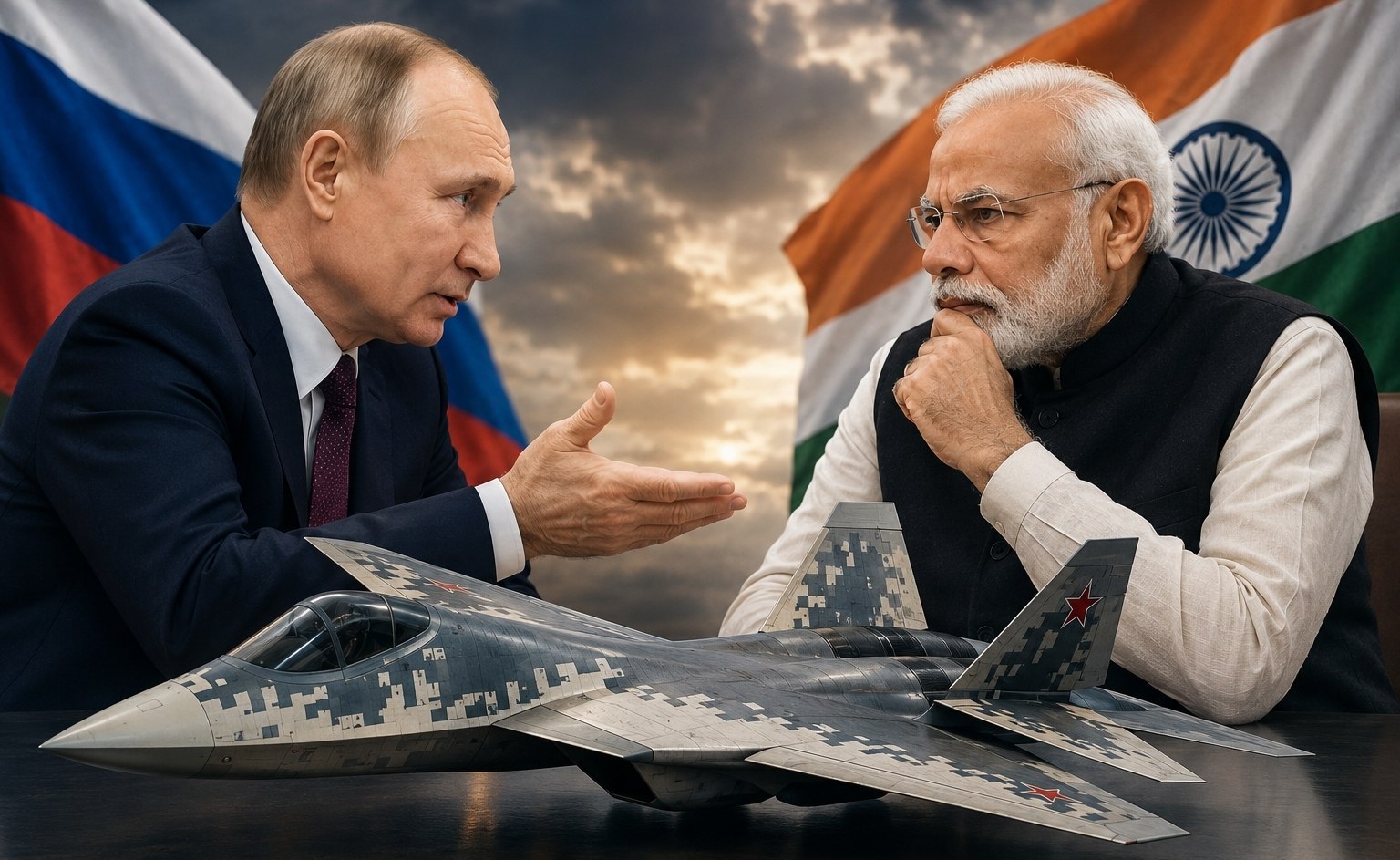
MOSCOW/NEW DELHI: Russian President Vladimir Putin has publicly renewed an offer for India to jointly produce the SU-57 fifth-generation fighter aircraft, stating that the project would proceed "without any restrictions" and would incorporate Indian technologies. In remarks that referenced an earlier proposal, Putin noted that India had previously declined a similar offer, with Indian officials at the time indicating that Russia should first complete development of the aircraft before further discussions would be entertained. The SU-57 is now operational with the Russian Aerospace Forces, with limited exports to Algeria.
The Geopolitical Reality
The global fifth-generation fighter market remains highly constrained. Only three countries have fielded operational stealth fighters: the United States (F-22, F-35), China (J-20, J-35), and Russia (SU-57). The technological and industrial barriers to entry are substantial, leaving most nations as customers rather than producers.
For India, the regional military balance presents an urgent consideration. China has already developed and deployed its own fifth-generation platforms, with the J-35 expected to see export variants delivered to Pakistan in the near term. This would create an airpower asymmetry that India's current fleet of 4.5-generation Rafale fighters cannot fully address.
The United States has also actively marketed the F-35 to India, with senior American officials having made public pitches for deeper defense partnership. This creates a rare situation where both Washington and Moscow are openly competing to supply New Delhi with their premier combat aircraft.
"India is in the unusual position of being courted by both major military-industrial powers for a high-value, long-term platform commitment that would shape its air force for decades."
— WFI Editorial Board
The constraints on either option are significant. American systems typically carry technology transfer limitations and potential Countering America's Adversaries Through Sanctions Act (CAATSA) implications, as India discovered with its S-400 acquisition from Russia. Russian systems, meanwhile, face questions about spare parts reliability, production quality, and the long-term viability of defense industrial cooperation given Moscow's international isolation and economic constraints.
The View from Delhi
For Indian strategists, this renewed offer complicates an already difficult procurement calculus. The original Indo-Russian fifth-generation fighter program collapsed around 2018 over familiar disagreements: insufficient technology transfer, concerns about Russian industrial capacity, and the perennial risk that sanctions could disrupt supply chains. These structural issues have not disappeared.
The domestic alternative remains distant. India's own fifth-generation fighter program, the Advanced Medium Combat Aircraft (AMCA), faces timeline uncertainty. Even optimistic projections place operational entry in the mid-2030s—a gap that leaves a vulnerability window if regional adversaries field stealth capabilities sooner.
From New Delhi's perspective, the risk lies in platform lock-in. Either the F-35 or SU-57 would require decades of maintenance infrastructure, pilot training, weapons integration, and industrial commitment. The choice would also signal geopolitical alignment in ways that affect other relationships—access to American or Russian ecosystems in areas beyond defense.
Financial constraints deserve mention. India's defense budget faces competing demands, and the fiscal environment—shaped by energy costs, current account pressures, and domestic priorities—limits the pace at which any large program can proceed.
Strategic Implications
Several second-order effects merit attention for Indian policymakers:
- Technology absorption versus operational readiness: Joint production offers technology access but delays fielding. Off-the-shelf purchase speeds acquisition but deepens dependency. India has historically preferred the former, with mixed results.
- Sanctions architecture: Any major Russian defense purchase would require navigating or obtaining exemption from US sanctions frameworks. The political capital required is non-trivial, and success is uncertain.
- Regional signaling: The choice of platform communicates intent to China and Pakistan. It also affects how other partners—France, Israel, emerging suppliers—position themselves in the Indian market.
- Industrial base effects: A fifth-generation program, regardless of origin, would consume engineering talent and capital that might otherwise support indigenous programs. The opportunity cost is real even if unmeasured.
The SU-57 itself remains a subject of analytical debate. Questions persist about its stealth signature, sensor fusion, and engine performance relative to American or Chinese counterparts. The aircraft has seen limited operational use and minimal export success—factors that any Indian evaluation would need to weigh carefully.
What is clear is that indecision carries its own costs. As Pakistan moves toward acquiring Chinese fifth-generation capabilities, India's air force modernization timeline becomes more constrained. The window for a deliberative, long-term choice narrows with each year of delay.
Whether Putin's renewed offer represents a genuine opportunity or a recognition that Russia's own industrial limitations make Indian partnership necessary for SU-57 viability remains analytically indeterminate. What it does confirm is that Moscow continues to view New Delhi as a critical market for its defense industry—and that the competition for India's fifth-generation fighter commitment is intensifying rather than resolving.