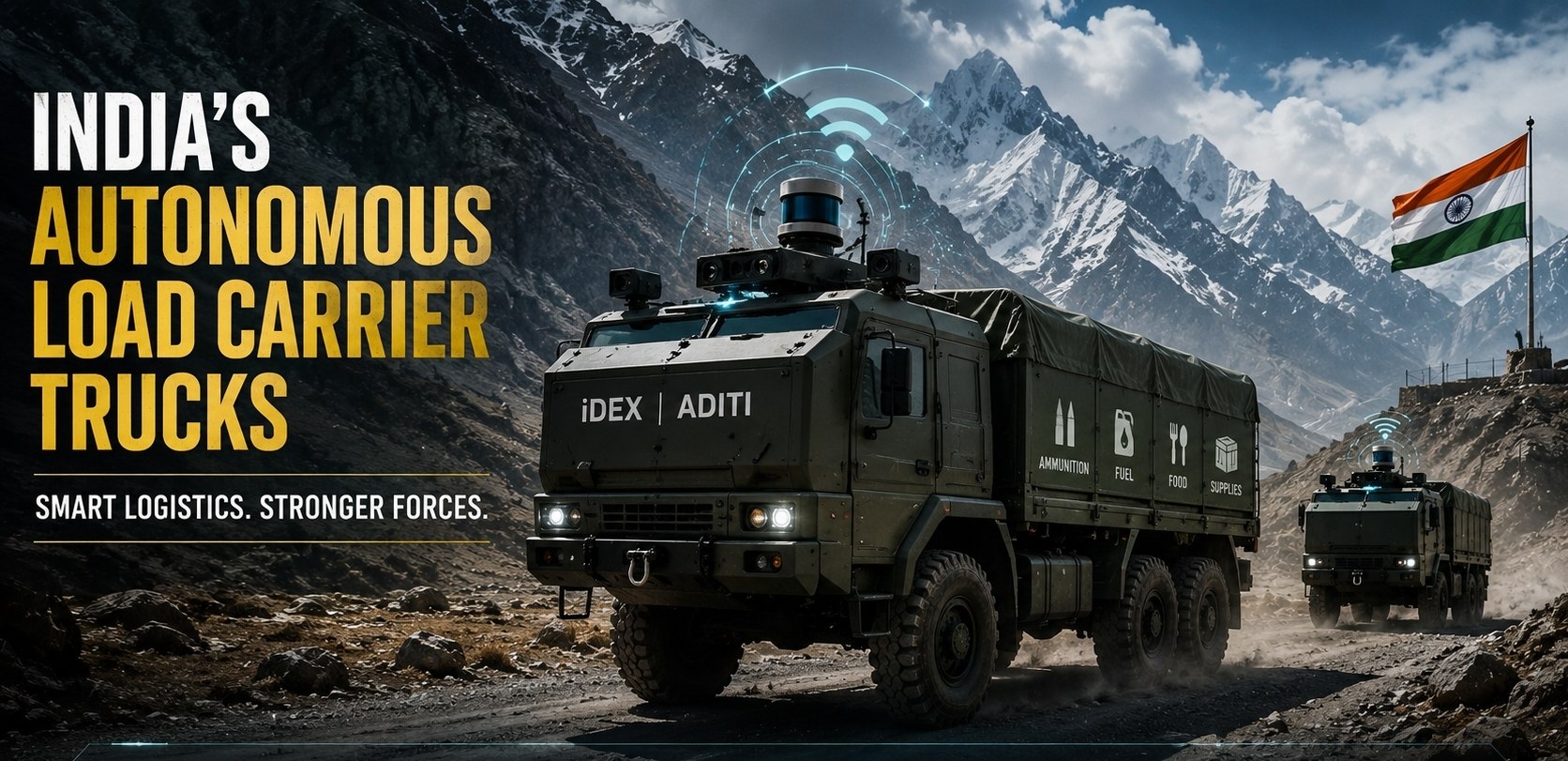
NEW DELHI: The Indian Army is advancing the development of autonomous land carrier trucks designed to transport supplies and heavy payloads through hazardous terrain with minimal human intervention. The initiative operates under the government's iDEX (Innovations for Defence Excellence) and Aditi Innovation Frameworks, which channel indigenous private-sector capability toward military applications. These unmanned vehicles are intended to address one of the most persistent challenges in military operations: sustaining troops in high-altitude regions, remote border areas, and active combat zones where traditional logistics networks face severe constraints.
The Geopolitical Reality
Autonomous logistics has emerged as a critical domain in military innovation across major powers. The United States, China, and several European militaries are investing substantially in unmanned transport systems to support future battlefield operations. This reflects a structural shift in how militaries conceptualize advantage—not merely through direct combat systems, but through the resilience and efficiency of supply chains.
The terrain along India's northern and eastern borders presents distinctive logistical demands. High-altitude operations in regions such as Ladakh require sustained delivery of ammunition, fuel, food, and equipment under conditions of extreme weather, limited road infrastructure, and proximity to adversarial positions. The source material notes that these conditions make logistics "one of the most demanding aspects of military operations." Autonomous systems that reduce human exposure to these hazards while maintaining supply continuity offer a operational utility that extends beyond simple cost or manpower savings.
The global pattern is clear: militaries are pursuing autonomous support systems with comparable urgency to autonomous combat platforms. A force that sustains itself faster, safer, and more reliably gains operational staying power that directly translates into tactical and strategic leverage.
The View from Delhi
For Indian strategists, this development raises several analytical considerations. First, the iDEX and Aditi frameworks represent a deliberate institutional bet on indigenous private-sector capacity to deliver military-relevant technology outside the traditional defence public sector undertaking model. Whether this approach can scale to meet operational requirements across multiple theatres remains an open question.
Second, the operational concept depends on technological maturity in areas where India is still building capability. The source indicates these vehicles will use "advanced sensors, artificial intelligence, navigation systems, and obstacle avoidance technologies." The reliability of such systems in contested electromagnetic environments—where adversaries may attempt to disrupt GPS, communications, or sensor fusion—has not been demonstrated in the public domain. For Indian planners, this creates a gap between developmental potential and deployable capability that will require careful assessment.
Third, the force structure implications are significant if the technology matures. Reduced manpower requirements for logistics missions could free personnel for other roles, or alternatively, allow the Army to sustain a larger deployed footprint with existing numbers. The trade-off between investment in autonomous platforms and traditional logistics capacity will require sustained analysis as costs and reliability become clearer.
Strategic Implications
The long-term significance of this program lies in how it fits within India's broader defence innovation ecosystem. The source frames this development alongside "autonomous trucks and underwater drones to hypersonic systems and quantum technologies" as part of a focused orientation toward "battlefields of the future." Whether this portfolio represents coherent prioritisation or diffuse aspiration will become apparent only through implementation outcomes.
For Indian military planning, several constraints merit attention:
- Integration challenges: Autonomous logistics must mesh with existing supply chains, command structures, and maintenance systems. Disruption during transition phases could degrade rather than enhance capability.
- Adversarial countermeasures: The source notes that autonomous trucks could reduce "exposure to enemy surveillance and attacks," yet the electromagnetic signatures and predictable routing of such systems may create new vulnerabilities.
- Terrain specificity: Systems validated in Ladakh's conditions may not translate automatically to other operational environments, such as the northeastern borders or desert terrain.
- Budgetary trade-offs: Investment in developmental autonomous platforms competes with immediate requirements in conventional modernisation.
"A force that can move supplies faster, safer, and more effectively gain a major operational advantage."
The development of autonomous logistics capability is not transformative in isolation. Its value will be determined by whether India can field it at scale, protect it from disruption, and integrate it into a larger operational concept that accounts for the specific challenges of its northern and eastern theatres. The direction is clear; the timeline and the depth of commitment are not.