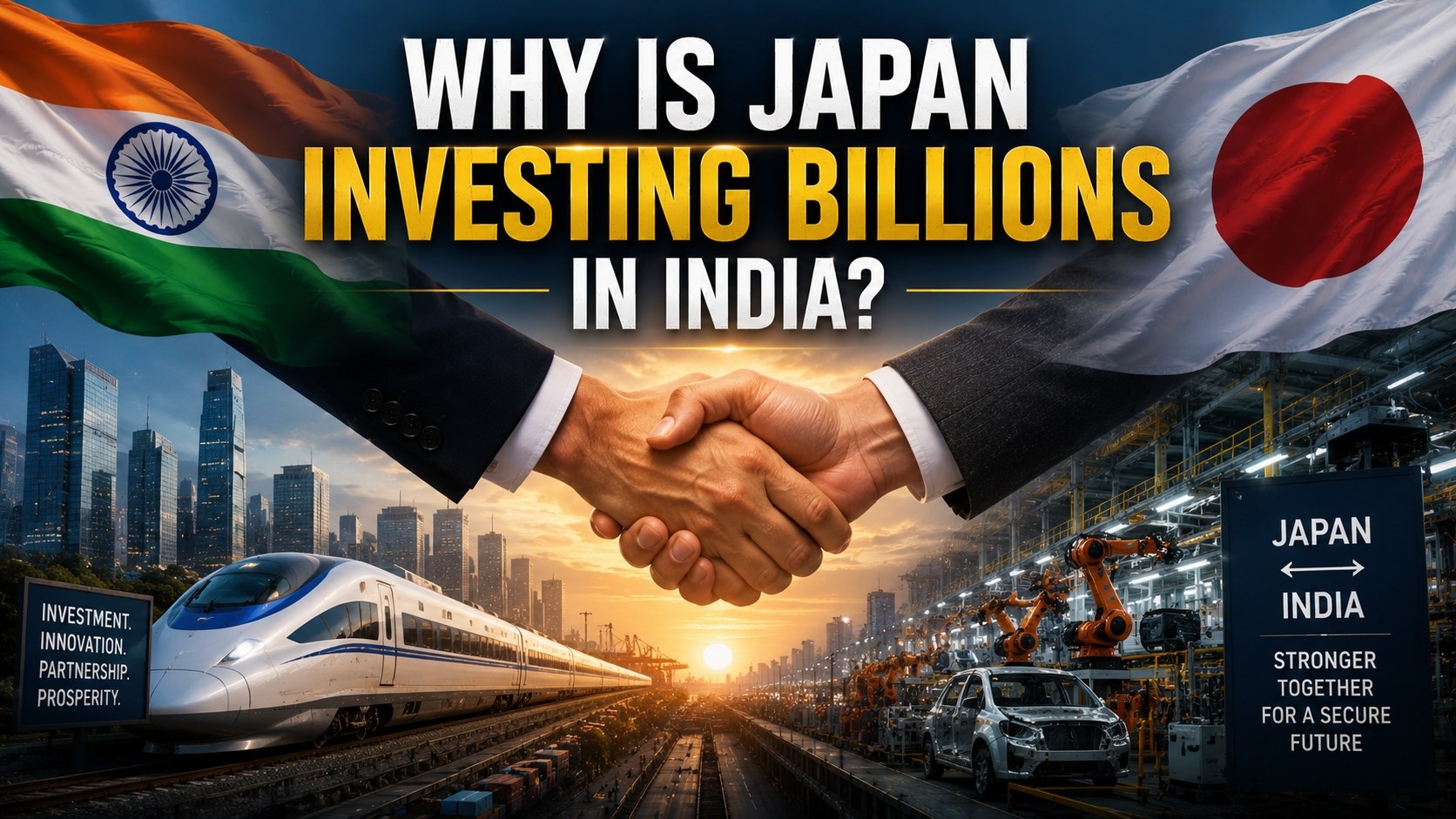
NEW DELHI: Japanese foreign direct investment in India has crossed $27 billion, according to data from the Japan External Trade Organization. More than 1,400 Japanese companies currently operate in India, having established over 5,000 local business establishments. This acceleration follows a longer-term pattern: Japanese banks and corporations, for decades major investors in China's industrial expansion, are now reallocating capital toward India as Chinese labor costs have risen sharply. Japanese Prime Minister Shigeru Ishiba is scheduled to visit India in July 2025, with expectations of significant investment announcements and defense cooperation discussions.
The Geopolitical Reality
The Japan-India investment dynamic reflects a structural shift in global manufacturing economics rather than a sudden political decision. Japanese capital played a foundational role in China's industrialization—funding factories, industrial parks, and export-oriented production that transformed China into the world's manufacturing hub. This model relied on a simple formula: Japanese capital combined with Chinese labor cost advantages.
That formula has eroded. Chinese wages in major cities now average ¥100,000–150,000 monthly, comparable in purchasing power terms to developed economy levels. The yuan has strengthened from 8.5 to approximately 6.5 per dollar over past decades. For Japanese investors, the cost arbitrage that made China attractive has diminished.
Comparative labor costs now favor alternatives:
- China: ~$8 per hour manufacturing wages in major industrial zones.
- Vietnam: ~$2 per hour, attracting labor-intensive assembly.
- India: ~$1 per hour, with a larger domestic market and regulatory reforms aimed at manufacturing promotion.
Japan has also revised its defense export policies, permitting lethal weapons sales including missiles and fighter jets to partner countries. This policy change, combined with investment flows, suggests a broader recalibration of Japan's strategic partnerships beyond its traditional U.S. security dependence.
"Japanese companies now view India as their most promising market."
— Japanese banking sector executive, cited in recent survey by Japan Bank for International Cooperation
The Japan Bank for International Cooperation has ranked India as its top overseas investment destination since 2022. This institutional ranking signals sustained capital commitment rather than speculative inflows. Japanese firms have explicitly framed India as "the next China" in strategic planning discussions—a comparison that carries both opportunity and burden for New Delhi.
The View from Delhi
For Indian strategists, this inflow presents a dual-edged structural opportunity. The scale of capital committed—Japanese officials have indicated a $68 billion investment target—could accelerate manufacturing capacity and infrastructure development. Yet the comparison to China raises questions about whether India's institutional framework can replicate the execution efficiency that made China attractive to Japanese investors initially.
The scheduled July visit of Prime Minister Ishiba, including planned travel to Assam and Northeast India, suggests Japanese interest extends beyond traditional industrial corridors. For New Delhi, this geographic diversification of interest aligns with its own Act East policy objectives, though the extent to which Northeast infrastructure can absorb large-scale Japanese investment remains constrained by existing connectivity and security challenges.
From New Delhi's perspective, the risk lies in expectation management. Japanese investment in India has historically faced friction points:
- Land acquisition delays affecting project timelines.
- Regulatory inconsistency across state-level implementation.
- Contract enforcement gaps relative to East Asian benchmarks.
The bullet train project and Delhi-Mumbai Industrial Corridor demonstrate Japanese commitment to long-horizon infrastructure, but also illustrate the patience required for returns. Whether India's current incentive structures significantly alter this timeline remains analytically uncertain.
Strategic Implications
The defense dimension of Japan's policy shift introduces new variables. Japan's revised lethal weapons export guidelines position India as a potential recipient of advanced systems. Whether this translates into concrete acquisitions—beyond the speculation regarding fighter jets or missile systems—depends on interoperability assessments, cost negotiations, and India's own procurement decision-making patterns, which have historically favored Russian-origin platforms with gradual Western diversification.
For Indian policymakers, the investment pact question presents a strategic choice. A formalized bilateral investment treaty could streamline Japanese capital inflows, but would require binding commitments on dispute resolution, intellectual property protection, and regulatory transparency that may constrain domestic policy flexibility. The alternative—continuing ad hoc project-by-project engagement—preserves flexibility but may limit the scale and speed of capital commitment.
The temporal dimension of this pivot warrants caution. The source material correctly notes that capital reallocation on this scale operates over decade-long horizons, not electoral cycles. Japanese exposure to China remains substantial; a full decoupling is neither occurring nor, from a Japanese risk-management perspective, necessarily desirable. India competes for incremental capital allocation with Vietnam, Indonesia, and other emerging manufacturing destinations.
Finally, the currency and macroeconomic context complicates straightforward optimism. Japanese investors evaluate returns in yen terms; rupee volatility, inflation differentials, and India's current account dynamics affect real returns in ways that headline investment figures obscure. The sustainability of India's attractiveness depends partly on whether wage and currency differentials remain favorable—a condition that India's own growth trajectory may gradually erode if productivity gains translate into labor cost increases before manufacturing scale is achieved.