
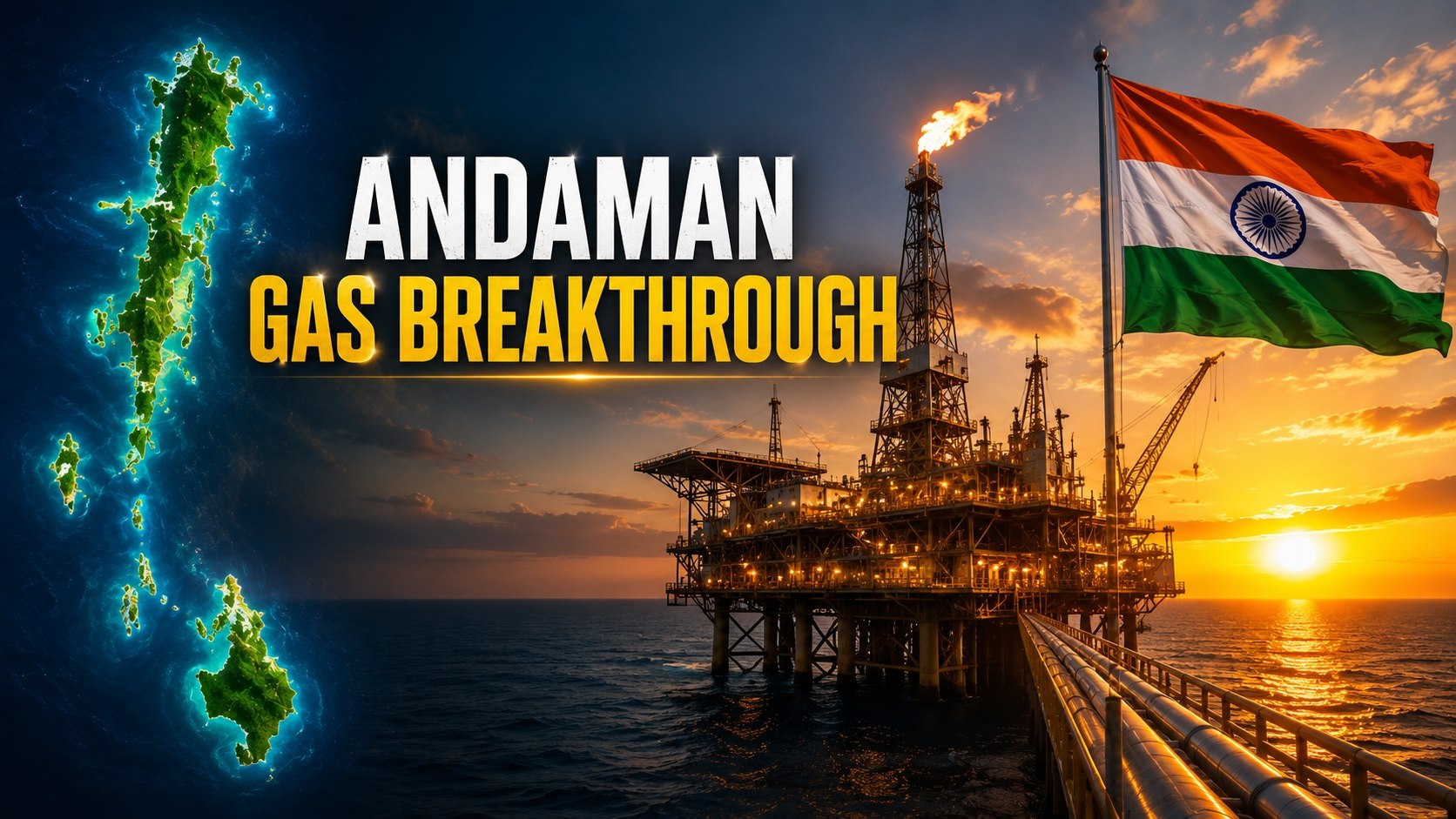
NEW DELHI: India's Minister of Petroleum and Natural Gas, Hardeep Singh Puri, shared video footage of a gas flare off the coast of the Andaman and Nicobar Islands, confirming a natural gas discovery in the vicinity of the Vijay Rupam wells. This marks the second such find in the area, following an earlier discovery at Vijay Rupam 2 that reportedly showed an 87% methane content. The government has framed these developments as part of a broader strategic push, termed Samudra Manthan, to accelerate deep-water exploration within India's Exclusive Economic Zone (EEZ).
The Prime Minister, in an address on 15 August 2025, articulated this mission-mode approach, stating that India aims to expand its oil and gas exploration coverage to 1 million square kilometres and attract up to $100 billion in sectoral investment by 2030. The Minister's social media post tagging major international energy firms—including TotalEnergies, BP, Shell, and ExxonMobil—signals an explicit invitation for foreign investment in India's offshore blocks. The geological proximity of the Andaman basin to Indonesia's North Sumatra region, where significant natural gas reserves have been previously documented, provides the empirical basis for India's exploratory focus in this maritime zone.
The Geopolitical Reality
Global energy markets are characterised by structural volatility, with supply disruptions and price fluctuations driven by conflicts in the Middle East and broader geopolitical realignments. Energy security has consequently become a primary strategic objective for major importing nations. India's dependence on hydrocarbon imports exposes its current account and fiscal stability to external shocks. The pursuit of domestic and near-shore reserves is therefore not merely an economic activity but a strategic imperative to reduce import dependency and insulate the economy from global supply chain disruptions.
The Andaman and Nicobar Islands sit at a critical maritime junction, overlooking the Strait of Malacca. Control and development of resources in this region carry both economic and strategic weight. Indonesia's success in monetising its North Sumatra gas fields provides a regional template, yet the Andaman basin remains under-explored relative to its geological potential. India's decision to open its exploration sector more aggressively, including to foreign partners, reflects a calculated risk to accelerate resource identification before technological or competitive disadvantages crystallise.
The View from Delhi
For Indian strategists, the primary calculus is risk mitigation. The discovery of commercially viable hydrocarbon reserves in the Andaman Sea would diversify supply sources and reduce the strategic vulnerability associated with long-haul imports from the Persian Gulf and other distant suppliers. However, the timeline from discovery to production is lengthy and uncertain. The Minister's own estimate of 11 billion barrels of potential hydrocarbon resources is speculative until further exploratory drilling confirms reserve viability and extraction feasibility.
The decision to publicly tag international majors suggests that domestic capital and technical capacity are insufficient for the scale of exploration envisaged. This raises a question for India: whether the terms offered to foreign investors will strike a balance that secures technology transfer and capital inflow without ceding disproportionate revenue share or strategic control over critical maritime assets. The precedent of Indonesia—where foreign exploration led to domestic utilisation and export revenue—offers a model, but replication depends on geological luck, regulatory stability, and execution capacity.
Strategic Implications
The forward-looking risks are concentrated in three areas. First, exploratory failure. Deep-water drilling is capital-intensive with no guarantee of commercial finds. Sunk costs in unsuccessful wells divert resources from other strategic priorities. Second, environmental and ecological constraints. The Andaman and Nicobar Islands host sensitive marine ecosystems. Any large-scale extraction infrastructure must navigate stringent environmental protocols, which could delay or complicate project timelines. Third, geopolitical competition. The Bay of Bengal and the eastern Indian Ocean are increasingly contested spaces. Resource nationalism in the maritime domain could trigger friction with regional neighbours or external powers with interests in the Indo-Pacific.
From New Delhi's perspective, the risk lies in over-commitment to a hydrocarbon strategy that may yield results too late to address immediate energy security concerns, or that diverts investment from renewable transitions. The momentum generated by these discoveries must be weighed against the imperative to avoid locking the economy into fossil dependency as global energy architectures shift. The test for policymakers will be whether revenue generated—if commercial extraction materialises—is reinvested into technological and human capital, or dissipated through short-term fiscal obligations.
"India's Exclusive Economic Zone is vast, but geological potential does not equate to strategic certainty. The transition from discovery to dependable supply remains contingent on sustained investment, technical execution, and geopolitical stability in the maritime domain."
— WFI Editorial Board