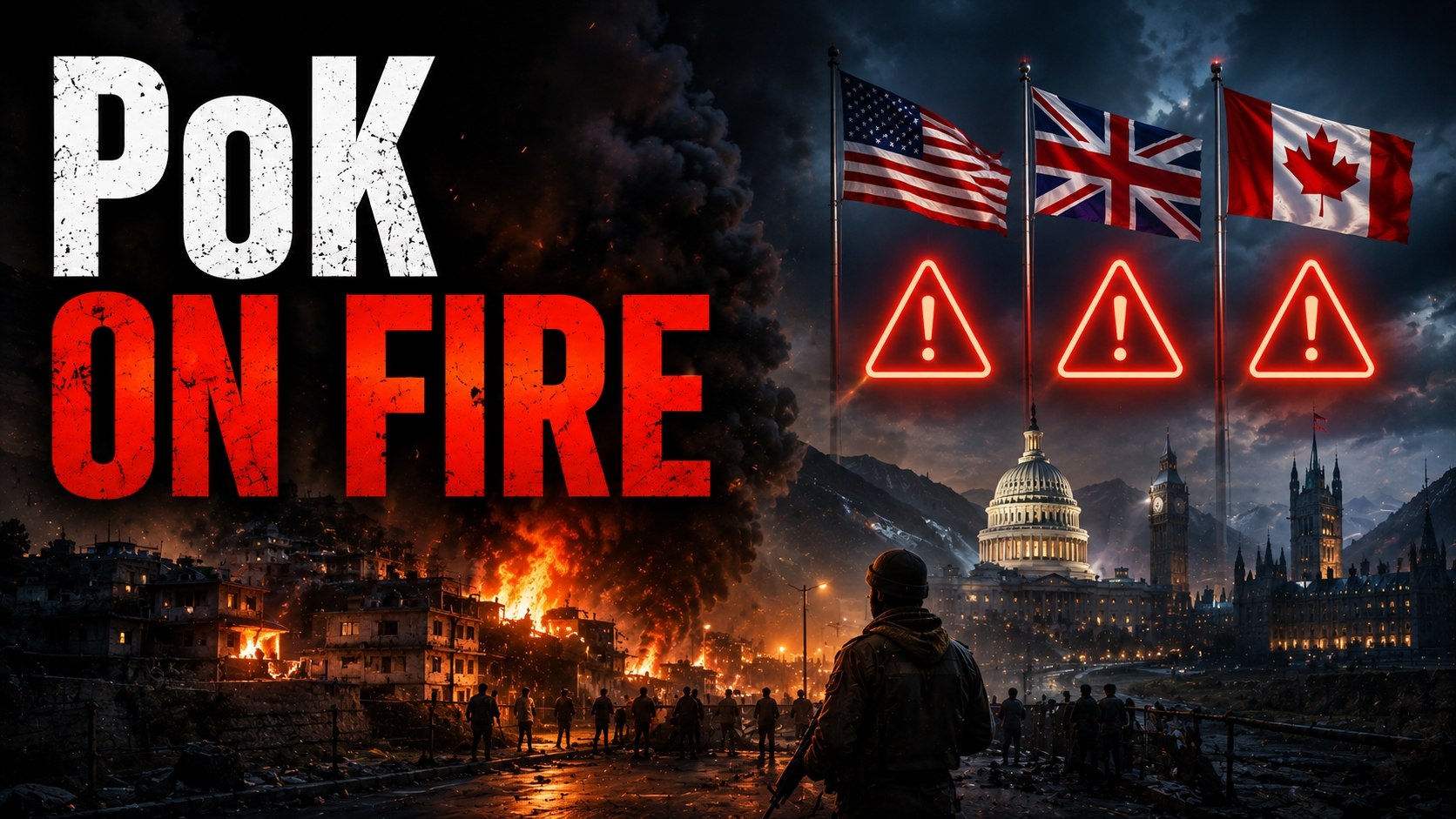
ISLAMABAD/POK: Large-scale protests are planned in Pakistan-Occupied Kashmir (POK) on June 9, 2025. In response, the governments of the United States, the United Kingdom, and Canada have issued travel advisories warning their citizens against travel to the region. The US Embassy in Pakistan specifically noted that the Joint Awami Action Committee (JAC) had organized the demonstrations across the region.
Pakistani authorities have reportedly imposed a communications blackout, cutting internet services and restricting media access in the area. The US advisory referenced travel warnings issued by local authorities in Azad Kashmir from June 5 to June 20. Similarly, Canada’s government stated it would be unable to provide consular assistance in areas with serious security concerns, noting that entry into Pakistan-administered Kashmir requires advance permission from Islamabad. In the UK, multiple Members of Parliament have reportedly written to their government requesting an inquiry into the situation.
Pakistan’s government has formally rejected what it termed "unwarranted remarks" regarding the region. In an statement, it defended its sovereignty and urged external parties to refrain from commenting on its internal affairs. The protests are reportedly driven by grievances over economic conditions, including inflation and electricity costs, as well as a perception of underinvestment in the region.
The Geopolitical Reality
The events highlight the enduring volatility of the Kashmir dispute, which remains a central flashpoint in South Asian geopolitics. For Islamabad, the dual challenge of managing internal dissent in the region while maintaining its international position is acute. The coordinated travel warnings from multiple Western capitals signal that events in POK are being monitored beyond the region, raising the diplomatic stakes for Pakistan.
The communications blackout and restrictions on media access are consistent with Islamabad's historical approach to unrest in the region. However, the inability to control the information environment entirely, particularly through social media, creates a vulnerability. The involvement of the Joint Awami Action Committee, an organization banned by Pakistan, indicates a degree of grassroots mobilization that is not easily attributed to external actors. This complicates the narrative for Islamabad, which often frames dissent in POK as externally fomented.
The timing of these events is also notable. Pakistan is reportedly planning elections in the Gilgit-Baltistan region. The scale of public anger, fueled by economic grievances, could undermine the credibility of any electoral process. Furthermore, the region's strategic importance is heightened by its proximity to the China-Pakistan Economic Corridor (CPEC) and the Karakoram Highway, making internal instability a concern for Beijing as well.
The View from Delhi
From New Delhi’s perspective, the situation presents a complex set of considerations. On one hand, the protests and the international attention they generate reinforce India’s long-standing position that Pakistan’s administration of the region is illegitimate. An official Indian statement referenced the need for Pakistan to vacate POK. The visibility of public discontent undermines Islamabad’s claims of benevolent governance in the territory.
However, New Delhi must also weigh the risks of escalation. Any perception that India is orchestrating or even tacitly supporting the unrest could provide Pakistan with a pretext to deflect from internal governance failures and rally nationalist sentiment. Indian strategists would likely prefer to observe the situation unfold organically, allowing the economic and political contradictions within Pakistan-administered Kashmir to create their own pressure on Islamabad without Indian fingerprints.
The Western travel warnings also create a diplomatic dynamic that requires careful monitoring. If the US, UK, and Canada adopt a more critical stance toward Pakistan's actions in POK, it could shift the diplomatic equilibrium. Conversely, if the protests are successfully suppressed and the issue fades from the international agenda, it would demonstrate the limits of external leverage over Pakistan's internal security decisions.
Strategic Implications
The immediate risk is the potential for a violent crackdown in POK, which could lead to a refugee crisis or cross-border tensions. For India, a sudden influx of people from POK, or a Pakistani attempt to externalize the crisis by creating a distraction along the Line of Control, would pose significant security challenges. The Indian military and security establishments would need to remain on high alert.
Looking further ahead, sustained unrest in POK could alter the strategic calculus in the region. If the Joint Awami Action Committee or similar groups gain political traction, it could lead to a more decentralized and unpredictable political landscape in the territory. This could complicate any future negotiations over Kashmir, as the traditional binary of Indo-Pakistani dialogue would have to account for new local power structures.
Finally, the episode underscores the importance of information warfare and narrative control in modern conflict. Pakistan's decision to cut internet access, while effective in the short term, risks drawing more international scrutiny. For India, the challenge lies in leveraging the factual reality of unrest in POK without being seen as an instigator, ensuring that its own narrative of the region's status remains consistent and credible on the global stage.