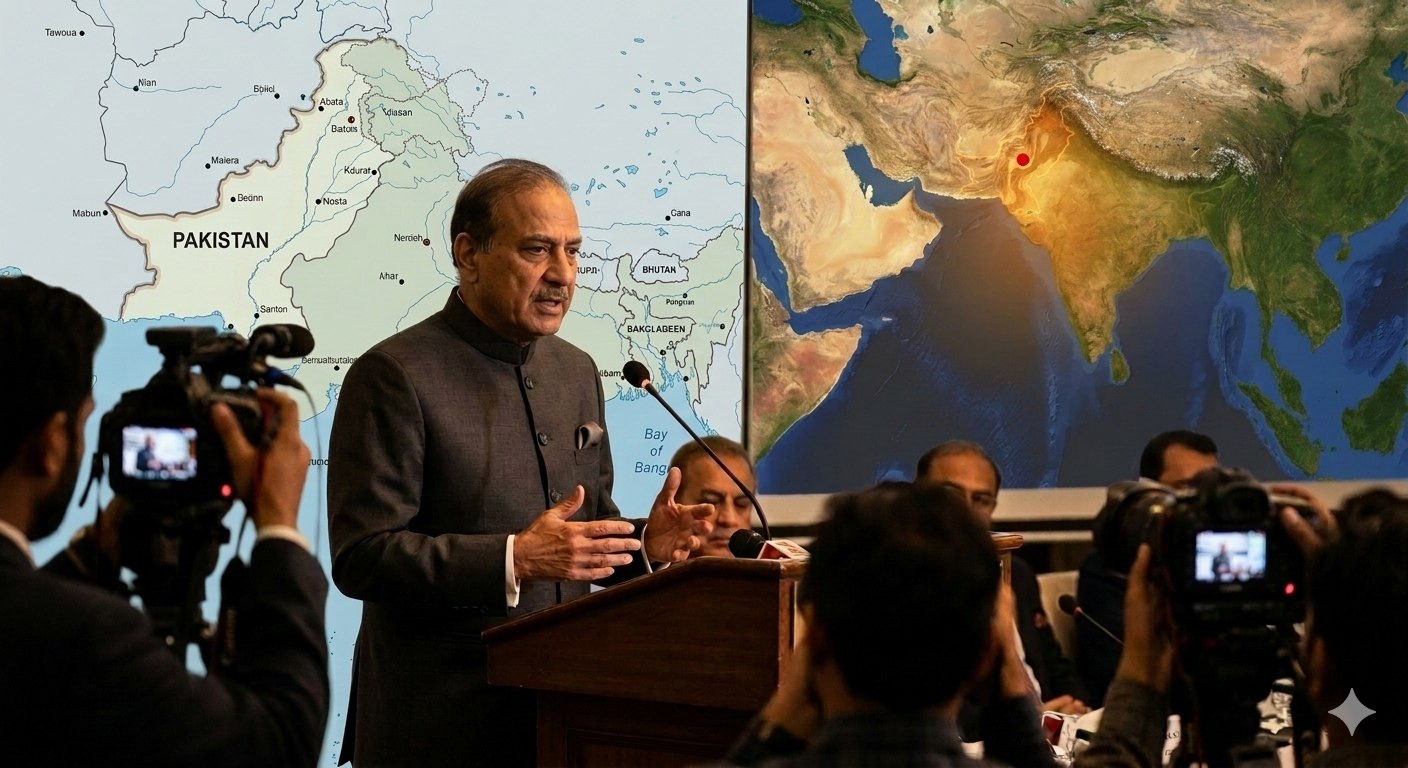
ISLAMABAD: Abdul Basit, who served as Pakistan’s envoy to India from 2014-2017, told an interviewer that if the United States launched a military operation against Pakistan, Islamabad’s response would be to target Delhi and Mumbai with missiles. Basit, now retired from active diplomacy, described this as a standing policy option rather than a hypothetical contingency.
The Geopolitical Reality
Basit’s remarks surface while Washington is reassessing the security profile of South Asian nuclear-armed states. The US Congressional Research Service lists Pakistan alongside North Korea, Russia and China as states whose long-range missile advances are under active review. Israel has begun open-source monitoring of Pakistan’s strategic arsenal, a step that in the Iranian case preceded the April 2024 escalation.
Tehran’s experience colours Islamabad’s strategic debate. After the 2003 fall of Baghdad, Iran built a mosaic defence: devolved launch authority to regional commanders and a cost-imposing doctrine that strikes US-aligned Gulf economies when Tehran itself is attacked. Pakistani analysts now debate whether to import the same template.
“If the United States attacks Pakistan, we will target Delhi and Mumbai in India… we have no other option.”
— Abdul Basit, former High Commissioner of Pakistan to India
The View from Delhi
For Indian planners, the statement is significant not because it reveals new Pakistani capability but because it confirms India’s assigned role in Islamabad’s deterrence choreography: a target of first resort when Pakistan’s nuclear reach cannot hold the continental United States or Israel at risk. The logic is cost-imposition—raise the political price for any US operation by threatening the security of a state whose economic value to Washington is orders of magnitude higher than that of Pakistan.
Delhi therefore faces a second-order deterrence problem: it must prepare for a Pakistani launch that may be triggered not by bilateral escalation but by a super-power clash in which India is formally uninvolved. The strategic dilemma is to deny Pakistan the ability to externalise its crisis without becoming the primary stakeholder in a US-led containment scheme.
Strategic Implications
- Arms-race accelerator: Pakistan’s missile-modernisation programme—especially the 2,750-km-range Ababeel MIRV—already covers all of India; Basit’s framing signals intent rather than reach.
- US-India technology cooperation: Washington’s interest in limiting South Asian nuclear risks could translate into faster integration of Indian air-defence assets with US early-warning architecture, complicating New Delhi’s insistence on strategic autonomy.
- Civil-defence burden: India’s tier-one cities must now plan for a saturation missile threat whose timing is divorced from predictable Indo-Pak crisis cycles; this shifts budgetary priority from frontier force projection to urban passive defence.
Whether Basit spoke with official sanction or as a private citizen is unknown, yet the signal value remains: Pakistan has publicly locked India into its deterrence paradigm. For New Delhi, the policy takeaway is not to seek reassurance from Islamabad but to ensure that any US action—economic, cyber or kinetic—does not automatically convert Indian territory into the release valve for Pakistani retaliation.