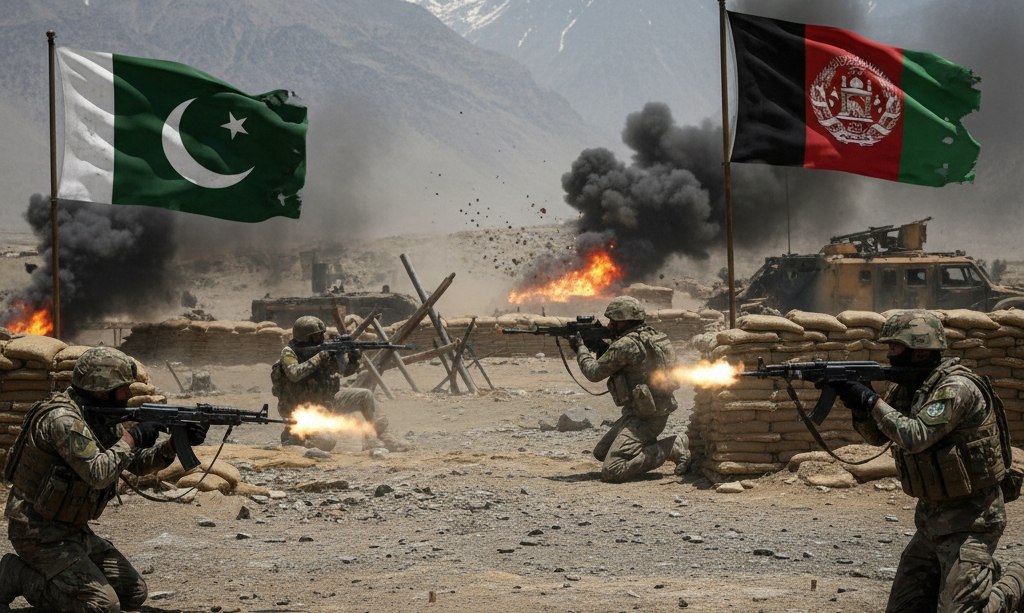
ISLAMABAD: Pakistani Defence Minister Khawaja Asif declared an "open war" on Afghanistan in a 26 February social-media post, accusing the Taliban of turning the country into a "colony of India" and exporting terrorism into Pakistan. The statement coincided with unverified reports—accompanied by apparently fake footage—of an Afghan MANPADS unit shooting down a Pakistani F-16 over Kabul. Islamabad has not confirmed any aircraft loss.
The Geopolitical Reality
The announcement marks a rhetorical escalation after months of cross-border shelling that killed an estimated 133 people in eastern Afghanistan this month, according to Pakistani claims. Western and regional media have repeated the "open war" formulation, though neither side has formally invoked Article 51 of the UN Charter or mobilised reserves.
Taliban-controlled Afghanistan possesses no modern integrated air-defence network. Its residual capabilities include an unknown number of U.S.-supplied FIM-92 Stinger MANPADS and Soviet-era ZU-23-2 autocannons—systems that can threaten low-flying aircraft but are unlikely to deny airspace to a modern air force operating at medium altitude.
Asif's statement explicitly links the Taliban's perceived alignment with India to Pakistan's 2021 expectation that a U.S. withdrawal would produce regional stability. By re-framing the Taliban as an Indian proxy, Islamabad signals a doctrinal shift: from managing instability to militarily suppressing it.
The View from Delhi
For Indian planners, the episode underscores two structural realities. First, any Pakistani ground incursion into eastern Afghanistan would aim to create a security buffer and, potentially, a land corridor toward Bagram airfield—a site repeatedly referenced by Pakistani commentators as a future strategic asset. Control of Bagram would give Islam bargaining leverage with Washington and Beijing while flanking India's Central Asian outreach via Iran's Chabahar port.
Second, Delhi's material exposure is indirect. India has no defence treaty with Kabul, no troops on Afghan soil, and no obligation to respond kinetically. Yet a Pakistani seizure of Afghan territory would tighten the Pakistan-China arc around India's western horizon, complicating future intelligence cooperation with any post-Taliban regime.
Strategic Implications
Risk 1: If Pakistan escalates from air strikes to limited ground incursions, the Taliban's asymmetric response is likely to target Pakistani border posts, risking a protracted attritional campaign that bleeds Pakistan's army without delivering a decisive outcome.
Risk 2: A sustained Pakistani campaign could push the Taliban deeper into a tactical embrace with Beijing and Moscow, both of which oppose an indefinite U.S. return but tolerate Pakistani overtures if they constrain Indian influence.
Risk 3: For India, the premium on intelligence collection inside Afghanistan rises. Delhi's leverage remains economic and diplomatic; kinetic intervention is improbable unless Pakistani forces threaten Indian nationals or assets—a threshold that, as of now, appears distant.
The open-war declaration does not, by itself, alter territorial realities. It does, however, shift the burden of escalation onto Islamabad while exposing the Taliban's vulnerability to airpower. From New Delhi's vantage, the immediate task is to monitor whether Pakistani operations remain punitive or evolve into a territorial grab that would redraw the strategic map of the Hindu Kush.