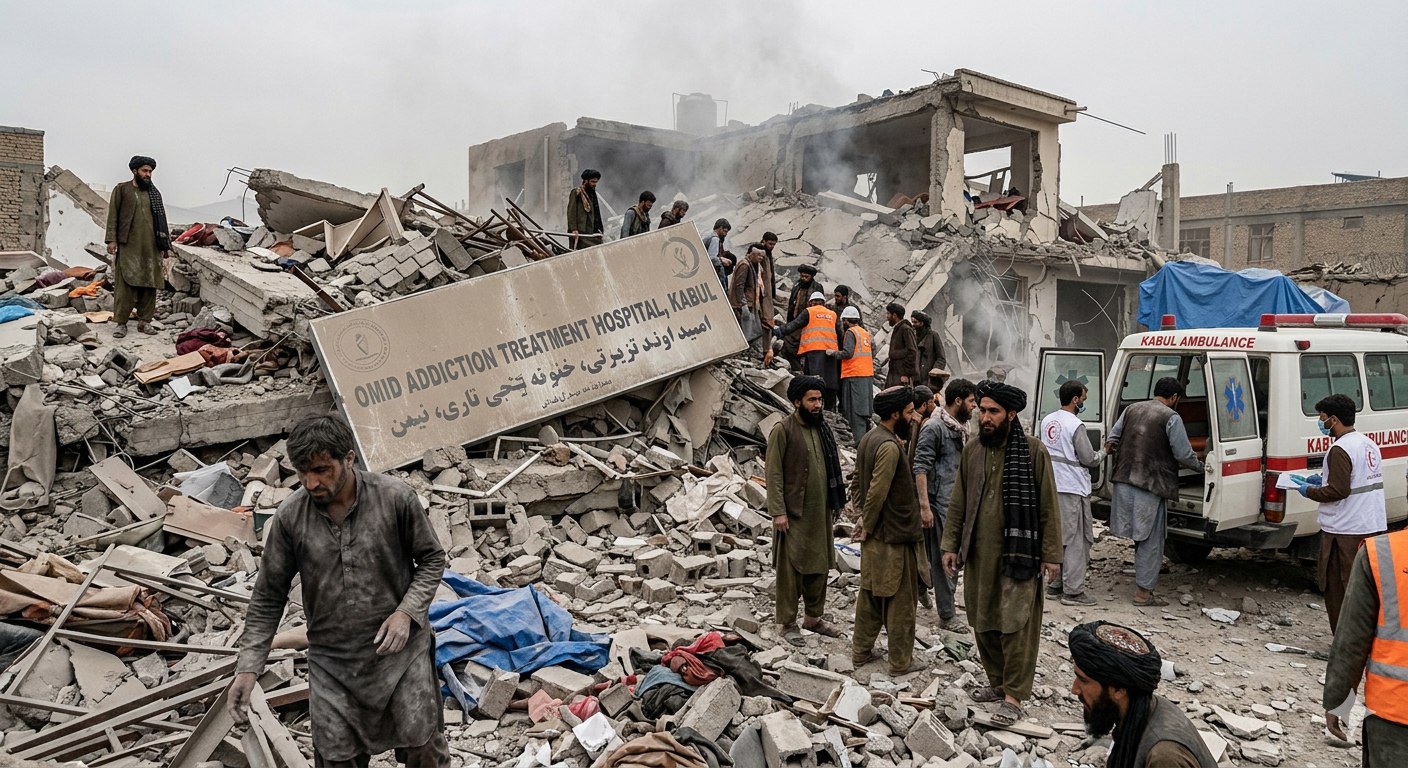
KABUL: Pakistan’s air force attacked a 2,000-bed drug-treatment hospital in central Kabul on the night of 16 March. The Taliban administration reports at least 400 fatalities; the toll is expected to rise as rubble is cleared. Islamabad has neither confirmed nor denied the raid, while the Indian Ministry of External Affairs condemned the strike as a “cowardly and unconscionable act of violence” against a civilian medical facility.
The Geopolitical Reality
The raid forms part of a low-visibility but escalating air campaign that began weeks earlier. Pakistani aircraft have repeatedly hit targets inside eastern Afghanistan—most recently the former U.S.-built Bagram airbase—signalling a shift from border skirmishes to strategic interdiction deep on Afghan territory.
The hospital, operating 24/7 during Ramadan, had no military protection. Satellite imagery circulating on Afghan social-media accounts shows collapsed wings and scorch marks consistent with precision-guided munitions. Islamabad’s apparent objective is to degrade Taliban sanctuaries used by the Pakistani Taliban (TTP), but the choice of a medical facility has triggered accusations of a war-crime.
Western capitals, Beijing and the Gulf states have remained silent, leaving Delhi as the only regional power to issue an explicit condemnation. The muted international reaction underscores a broader attention deficit: simultaneous crises in Gaza, the Red Sea and Ukraine are absorbing diplomatic bandwidth, giving Islamabad operational room.
The View from Delhi
For Indian planners, the episode confirms three structural trends. First, Pakistan’s threshold for cross-border force has risen; airpower is now being used beyond the traditional ground-based artillery duels along the Durand Line. Second, the absence of external censure—especially from Washington and Beijing—reduces the reputational cost for Islamabad and raises the probability of repeat strikes. Finally, the Taliban’s limited air-defence network means Kabul cannot deter future raids; its retaliatory options are restricted to sponsoring insurgent action inside Pakistan, a cycle Delhi watches for its own contagion risk into Jammu & Kashmir.
New Delhi’s public denunciation also serves a secondary purpose: it pre-empts Pakistani attempts to moral-equate Indian air operations (Balakot 2019) with the hospital bombing, reinforcing the distinction between strikes on non-state training camps and attacks on protected medical sites under international humanitarian law.
Strategic Implications
The hospital strike pushes the Pakistan–Afghanistan conflict toward formal war. Kabul’s statement that it will “deal with Pakistan in its own language” hints at asymmetric retaliation—possibly TTP offensives into Khyber Pakhtunkhwa or missile/drone attacks on Pakistani border towns. Islamabad, in turn, may use any Taliban response as casus belli for a limited ground incursion, calculating that global powers will prioritise other theatres.
For India, the key variable is escalation velocity. A Pakistani ground operation would tie down up to two army corps on the western frontier, reducing reserves available for the eastern border with India. Conversely, a Taliban resurgence in Pakistani border regions could re-energise anti-India groups such as Jaish-e-Mohammed or Lashkar-e-Taiba as Islamabad seeks proxy leverage to manage two fronts.
Delhi therefore faces a monitoring imperative: enhanced technical intelligence along the Durand Line and accelerated delivery of spare parts for Afghanistan’s remaining Mi-17 and Mi-35 fleets—quiet measures that raise Taliban defensive capacity without crossing into overt military alignment. The longer the air war continues, the higher the probability that Pakistani airspace management and logistics will be stretched, offering India indirect strategic breathing room on the Line of Control.
"Targeting a hospital during Ramadan illustrates both the moral collapse and the strategic desperation of the Pakistani security establishment."
— Afghan Cricket Board statement