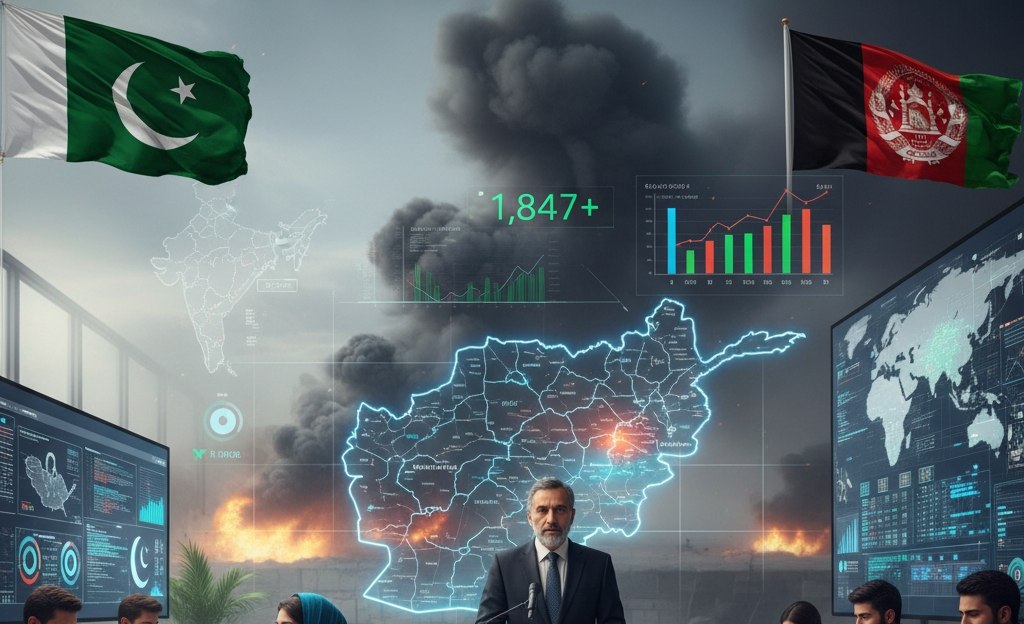
KABUL: Pakistan’s air force conducted fresh strikes on eastern Afghanistan this week, with Taliban officials reporting 70 civilians dead—mostly women and children—in Paktika and Nangarhar provinces. The raids, timed during Ramadan, flatten homes and a religious school, prompting Kabul to vow retaliation and India to issue a rare public condemnation.
The Geopolitical Reality
The attacks continue a pattern seen since November 2024: Pakistan bombs Afghan border districts, claims anti-Pakistan militants are being targeted, and returns to base before Kabul can respond. Civilian casualties keep rising; fatality counts have moved from single digits to the current toll in under six months.
The Taliban’s information response is now overtly political. An Urdu-language song released in late 2024 labels the Pakistani military “namak-haram” (treacherous) and Washington’s proxy, signalling intent to shape opinion inside Pakistan. Urdu is not spoken natively in Afghanistan, so the choice of language is strategic messaging, not domestic consumption.
- Targets: Villages in Gayan (Paktika) and Sherzad (Nangarhar), both within 50 km of the Pakistan border.
- Alleged Rationale: Pakistani officials claim anti-state sanctuaries; Kabul says no militants present.
- Bagram Sub-text: Sources link the pressure campaign to U.S. interest in regaining control of Bagram air base, 70 km north of the strike zones.
“This is an attempt by Pakistan to externalise its internal failures.”
— Indian Ministry of External Affairs
The View from Delhi
New Delhi’s condemnation focuses on civilian harm and Ramadan timing, but the statement also reiterates support for Afghanistan’s sovereignty and territorial integrity. Three analytical points emerge for Indian planners:
First, every Pakistani strike deepens Taliban hostility toward Rawalpindi, widening a security buffer on India’s western flank. Second, Islamabad’s willingness to escalate amid nuclear-tipped deterrence suggests it calculates Washington’s acquiescence outweighs Afghan retaliation risk. Third, if U.S. lobbying is indeed encouraging the raids, New Delhi gains diplomatic space to criticise without confronting Washington directly.
The Bagram angle—if substantiated—would indicate great-power competition is now outsourced to local air campaigns, a model India has long opposed in the Subcontinent. Delhi therefore has an interest in keeping the Taliban government diplomatically engaged and economically viable, preventing a collapse that could justify further external intervention.
Strategic Implications
- Escalation Ladder: Taliban retaliation could include cross-border raids into Khyber Pakhtunkhwa or support for Baloch militancy, raising the heat on Pakistan’s multiple fronts.
- U.S. Mid-term Calculus: Any change in U.S. congressional control after November 2026 elections could dilute Trump-era support for the Bagram option, leaving Pakistan holding strategic risk without assured pay-off.
- Humanitarian Leverage: Repeated civilian targeting gives India, Iran and Central Asian states a legitimist narrative to co-ordinate relief diplomacy inside Afghanistan, diluting Pakistani influence.
- Information Warfare: Expect further Taliban media products—songs, videos, Pashto and Urdu memes—aimed at undermining Pakistan army’s religious-nationalist credentials.
Short-term, the bombing campaign keeps pressure on Kabul; long-term, it hardens anti-Pakistan sentiment inside Afghanistan and risks drawing regional powers into a stabilisation debate they prefer to avoid. For India, the priority is monitoring escalation while ensuring its humanitarian and infrastructure footprint in Afghanistan remains untouched by the crossfire.