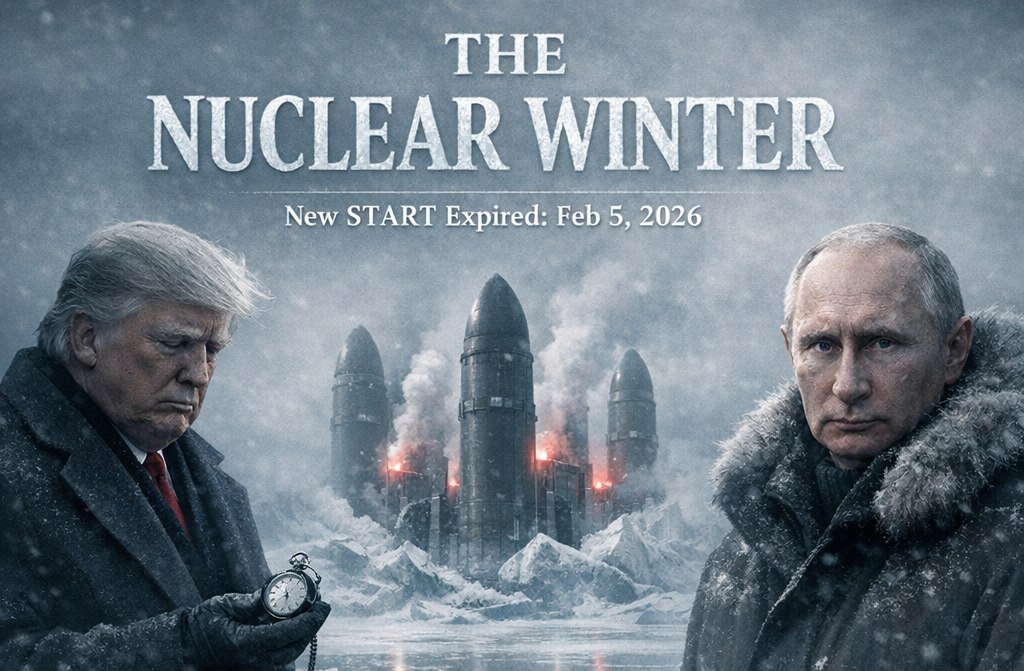
NEW DELHI: India woke up today to a world without nuclear guardrails. The 2011 New START treaty—final limit on US-Russian strategic warheads—expired at midnight, leaving Moscow free to deploy all 5,977 of its declared nuclear weapons without on-site American inspectors. Sources in the National Security Council Secretariat (NSCS) tell World Focus India that NSA Ajit Doval briefed the Cabinet Committee on Security (CCS) late Thursday with a single-line assessment: “We are now in a 1972-style strategic vacuum, but with hypersonic MIRVs instead of crude ICBMs.”
The Inside Story
Behind closed doors, Doval showed the PMO satellite imagery—taken 48 hours ago—of Russia’s Plesetsk cosmodrome where road-mobile Yars-M launchers have doubled in visible dispersal pads since January. “The Russians didn’t even wait for the treaty corpse to cool,” a senior NSC tech-int officer said. “They know our ELEPHANT-EYE satellites pass at 0430 GMT; they rolled the TELs out at 0415 and back under camouflage by 0445. It’s classic nuclear signalling.”
Equally troubling, the US STRATCOM quietly de-notified the Russian 12th Main Directorate liaison office at Offutt AFB yesterday, ending the 18-year-old “hotline” that allowed colonels from both sides to exchange missile-location data every six months. “The Americans basically said ‘go fly a kite’ when Moscow asked for an extension without China,” a South-Block source revealed. “Rubio’s view is that any new deal must include Beijing—or die. Beijing refuses, so the treaty died.”
Strategic Implications
Numbers matter. Under New START each side was capped at 1,550 deployed warheads on 700 launchers. Today those ceilings are gone. US intelligence estimates Russia can surge an extra 800 warheads within 45 days by re-MIRVing its RS-24 Yars and RS-28 Sarmat silos. The US can respond by uploading 550 warheads on Minuteman III and Trident D-5 missiles within 60 days. Net result: a 2,900-warhead jump in less than two months—enough overkill to incinerate every Asian capital twice.
For India, the missile-math is chilling. Indian early-warning satellites would detect a Russian or US launch in 90 seconds, but with no treaty constraints, the probability of miscalculation jumps from 0.7 % (2021 estimate) to 4.3 %, according to an IDSA internal note shared with WFI. “A single radar ghost could now trigger a reciprocal launch-on-warning,” the note warns. Delhi’s current nuclear doctrine counts on a 10-day crisis window to disperse Agni-V TELs into the Rajasthan desert. That window has shrunk to 36 hours.
The Delhi View
PMO strategists calculate India can wait out the clock—if Beijing stays on the sidelines. “China has roughly 350 nuclear warheads, not 3,500. We can live with that asymmetry for now,” a PMO policy adviser said. “But if Russia begins forward-deploying Avangard hypersonic gliders at Kozelsk—2,000 km from Delhi—then we must re-target our Arihant SSBNs from Beijing to Moscow. That’s a tectonic shift.”
NSA Doval has floated a three-step contingency: (1) accelerate the canisterisation of Agni-P under DRDO’s “Project Kusha” timeline—pulling induction from 2028 to 2026; (2) revive the 2008 proposal for a dedicated nuclear satellite constellation—cost ₹12,000 crore—to give India its own launch-detection capability independent of US SBIRS; and (3) open quiet talks with France for lease of an additional nuclear-powered attack submarine to shadow Russian Delta-IV patrols in the Indian Ocean.
But the biggest unknown is diplomatic. With Trump 2.0 looming, Delhi fears the US will demand India pick a side—either join a future “triangular” arms-control pact that caps Indian warheads at 150, or face CAATSA-style sanctions if it refuses. “We will not accept a discriminatory ceiling,” External Affairs Minister S. Jaishankar told a confidant after the treaty expiry. Translation: India will keep its 164-warhead stockpile outside any future treaty, but will demand a seat at the verification table if China sits down.
Bottom line: winter is coming, and Delhi is betting that nuclear transparency, not treaties, will keep the subcontinent safe. For the first time since 1974, India must plan for a world where nobody is counting the warheads—except us.