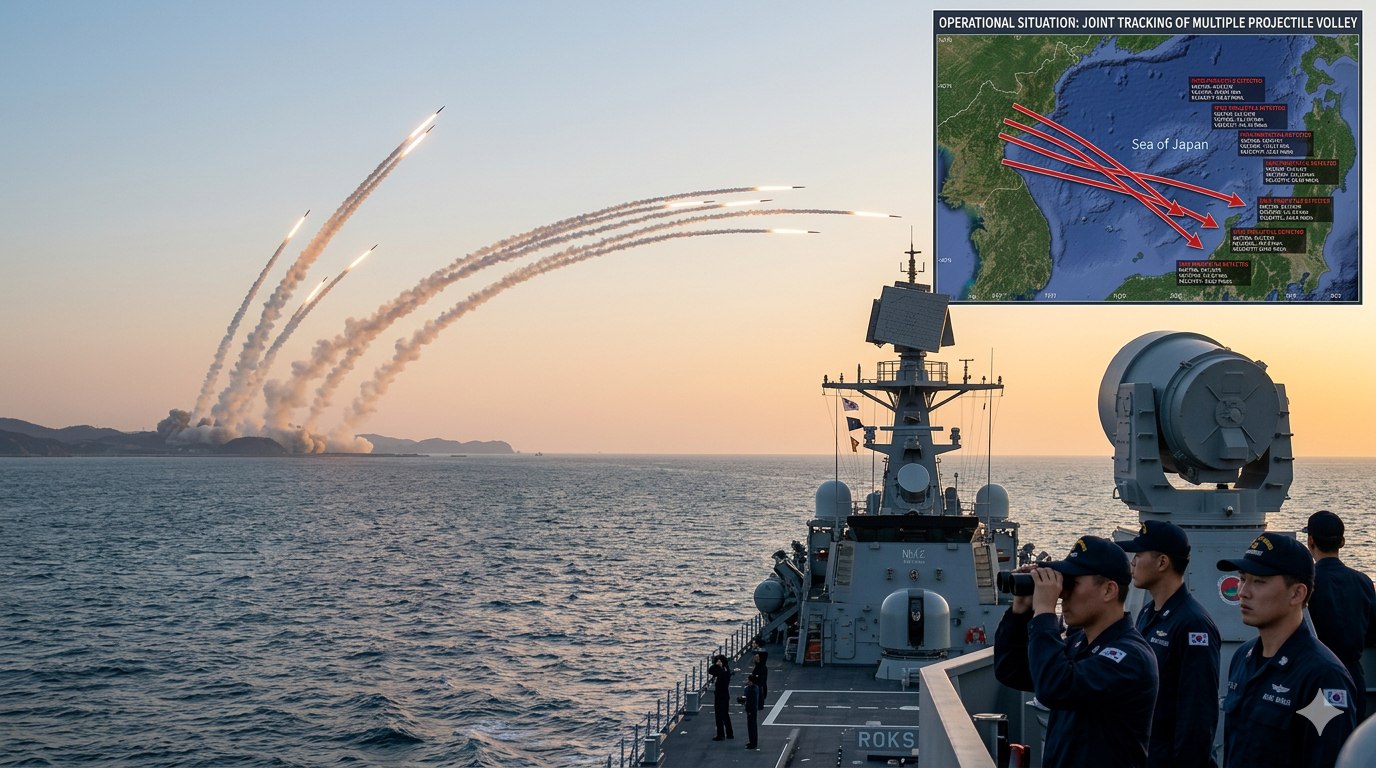
SEOUL: North Korea launched 10 short-range ballistic missiles within a single morning, all landing just outside Japan’s exclusive economic zone and prompting Tokyo to activate its national crisis-management protocol. The volley came hours after the United States began redeploying Patriot missile-defence units from South Korea to the Gulf, signalling a diversion of American military bandwidth from North-east Asia to the Middle East.
The Geopolitical Reality
The missile tests are calibrated to exploit two simultaneous US pre-occupations: the protracted Gaza-Israel conflict and the risk of wider Iranian escalation. Washington has already moved at least one Patriot battery from Osan air-base to Saudi Arabia, according to Japanese and South Korean media, and is reviewing the posture of a second.
- 10 Missiles: Fired in salvoes, range ~600 km, apogee ~100 km.
- Sea of Japan impact: 12–15 km outside Japan’s EEZ.
- US–ROK drill: The launches responded to a just-concluded combined exercise.
- Crisis team: Tokyo’s emergency HQ activated within four minutes.
Japan’s coast-guard logged splash-down coordinates that show a deliberate bracketing of major trans-Pacific shipping lanes. The timing—days after Seoul and Washington concluded their largest live-fire drill of 2024—mirrors Pyongyang’s escalatory playbook: signal-cum-test, calibrate allied reaction, prepare the next technological leap.
“North Korea is not irrational; it is opportunistic. The moment it senses US forces stretched, it fires.”
— Former JSDF Joint Staff planner
The Patriot redeployment is officially temporary, but Asian officials note that once missile-defence units leave theatre they rarely return on the same scale. Gulf Arab states, facing drone and missile strikes from Iran-backed groups, have lobbied for extra coverage since December. Washington’s answer is to thin out its North-east Asian shield rather than tap its exhausted continental US pool.
The View from Delhi
India is not a treaty ally of any protagonist, yet the peninsula’s deterrence geometry affects New Delhi in three ways:
First, a weakened US conventional umbrella accelerates South Korea’s and Japan’s indigenous build-up, raising the long-term prospect of a multi-polar East Asia with more ballistic-missile submarines and indigenous enrichment—technologies India monitors for export-control leakage.
Second, every US asset moved west is one less unit available for rapid dispatch to the Indian Ocean. If the Middle East consumes US air-defence capacity, Washington’s ability to assist in a future Indian contingency—however hypothetical—shrinks, reinforcing Delhi’s strategic autonomy doctrine.
Third, North Korea’s provocations complicate China’s balancing act: Beijing must restrain Pyongyang enough to keep Seoul out of a US-led “Asian NATO,” yet not so much that it loses leverage. A distracted US gives China tactical room but also increases the risk of a peninsula incident that could drag in American forces at a moment Beijing prefers them focused on Taiwan contingencies. India watches this contradiction because any kinetic flare-up would spike energy prices and test UN Security Council diplomacy where India may hold a veto-relevant position.
Strategic Implications
The episode confirms a structural trend: US force generation is approaching its global ceiling. North Korea’s nuclear status already deters large-scale retaliation; repeated missile diplomacy now tests whether Washington’s security commitments can survive simultaneous regional crises.
For Seoul and Tokyo, the takeaway is that extended deterrence is becoming conditional. Both will increase defence spending, seek greater intelligence sharing and accelerate missile programmes that can reach North Korean launch sites within minutes. The risk is pre-emptive postures on hair-trigger alert.
For India, the lesson is transactional: American security goods are market-priced, time-bound and location-fluid. New Delhi’s hedging—multilateral naval exercises, domestic ballistic-missile defence, diversified arms suppliers—looks prudent, not ideological, when even treaty allies can lose coverage overnight.