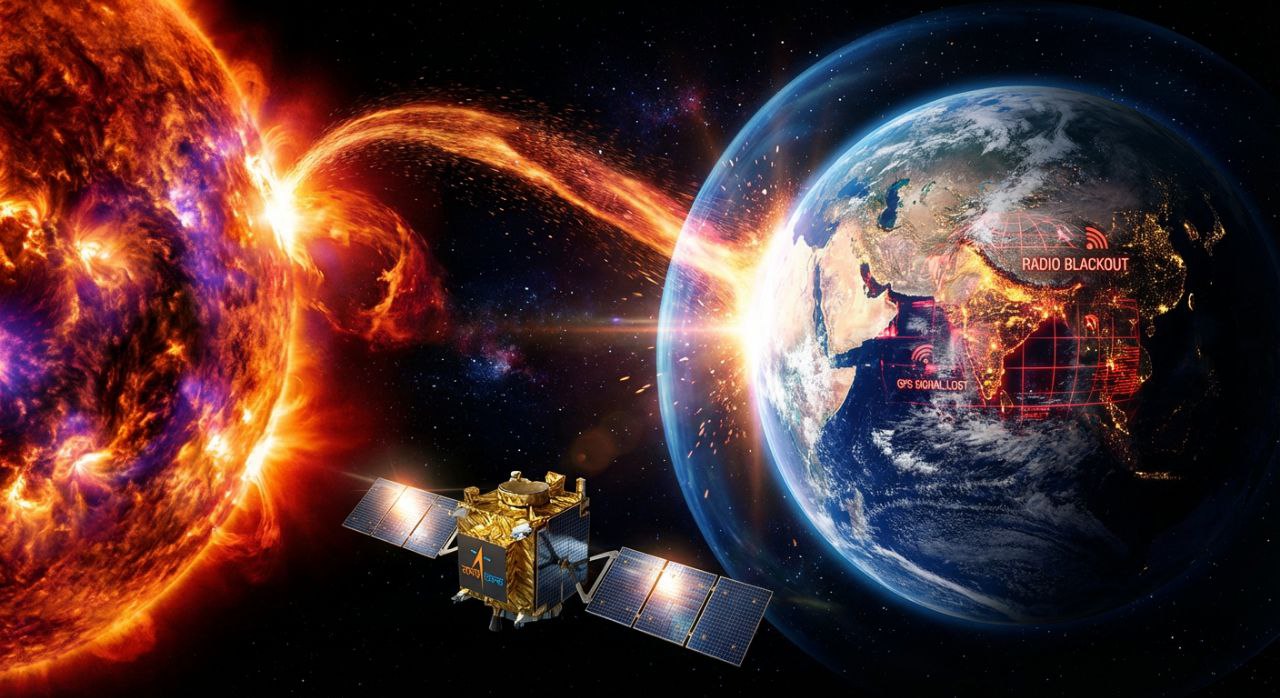
NEW DELHI: The National Security Council has told the PMO that India is staring at a “Category-R5 communications kill-switch” after an X8.1-class solar flare erupted from sunspot cluster AR 3696, forcing ISRO to place 52 operational Indian satellites under 24-hour watch and order power-grid operators in Punjab, Haryana and Uttar Pradesh to keep 765-kV transformers on hot-standby.
The Inside Story
Sources confirm that on the morning of 31 January, Dr. Nilek Desai, chief of ISRO’s Space Weather Cell, dialled National Cyber-Security Coordinator Lt-Gen (retd) Rajesh Pant with a blunt message: “We have eight minutes from flare to first impact; this is an X8.1, ten times the energy of the July-2022 flare that knocked out Starlink’s 38 satellites.” Within 90 minutes, the NSC convened a hush-hush video call where Principal Scientific Adviser Ajay Sood warned Cabinet Secretary Rajiv Gauba that “an R4-plus radio blackout will blind HF links used by the IAF’s Jaguar squadrons and the Navy’s P-8I fleet in the Indian Ocean.”
ISRO’s Bengaluru centre has since been downloading “dark frames” from all INSAT, GSAT and RISAT platforms every 30 minutes to check for single-event upsets. A senior scientist told World Focus India: “We have tilted Cartosat-3’s solar panels 17° off-point to reduce particle bombardment; NavIC timing satellites are on autonomous mode to prevent navigation drift that could throw BrahMos off course.”
Strategic Implications
A Defence Research and Development Organisation (DRDO) risk note, shared with the PMO, estimates that a 12-hour blackout of the 8-12 MHz HF band will cripple forward air-base chatter along the Line of Actual Control (LAC) and force Sukhoi-30 pilots to fall back on satellite voice loops—precisely the channel China’s People Liberation Army Strategic Support Force (PLASSF) is honing in on. The note adds that if geo-magnetically induced currents (GICs) breach 100 A in the 400-kV grid, transformers at Ambala and Pathankot—both hosting IAF staging areas—could saturate, taking 48-72 hours to repair under wartime logistics.
Commercially, India’s oil-import bill could spike by USD 1.3 billion if Very-Large-Crude-Carriers (VLCCs) lose GPS lock and drift in the congested Strait of Malacca, forcing refiners to idle units at Paradip and Jamnagar. “One missed tide window costs Reliance 400 kbpd throughput,” a Mumbai-based trader said.
The Delhi View
PMO strategists calculate they can “ride out” the storm for three reasons: (1) ISRO’s early-warning buys 6-8 hours before the coronal mass ejection (CME) hits Earth; (2) the Union Power Ministry has ordered all state load-dispatch centres to slash north-south HVDC flow by 15 % till 3 February, giving grid operators head-room; and (3) the Indian Army’s new quantum-key distribution network—tested last month in Jodhpur—can switch critical command links to optical fibre, immune to solar radio noise.
Yet the bigger play is diplomatic. “By going public with an R5 alert, India signals to Washington and Brussels that we can protect our space assets better than the EU’s Galileo, which crashed twice in 2022,” a senior MEA official boasted. “It strengthens our pitch for US technology-transfer on space-weather sensors under the iCET track.”
As night fell over Delhi, the normally bustling control room at the Power System Operation Corporation (POSOCO) was on a war-footing, operators watching geomagnetic K-index plots. “If K hits 7, we trip the 765-kV Bina-Jaipur line and go islanded,” an engineer whispered. “That’s the red line Doval signed off on.”