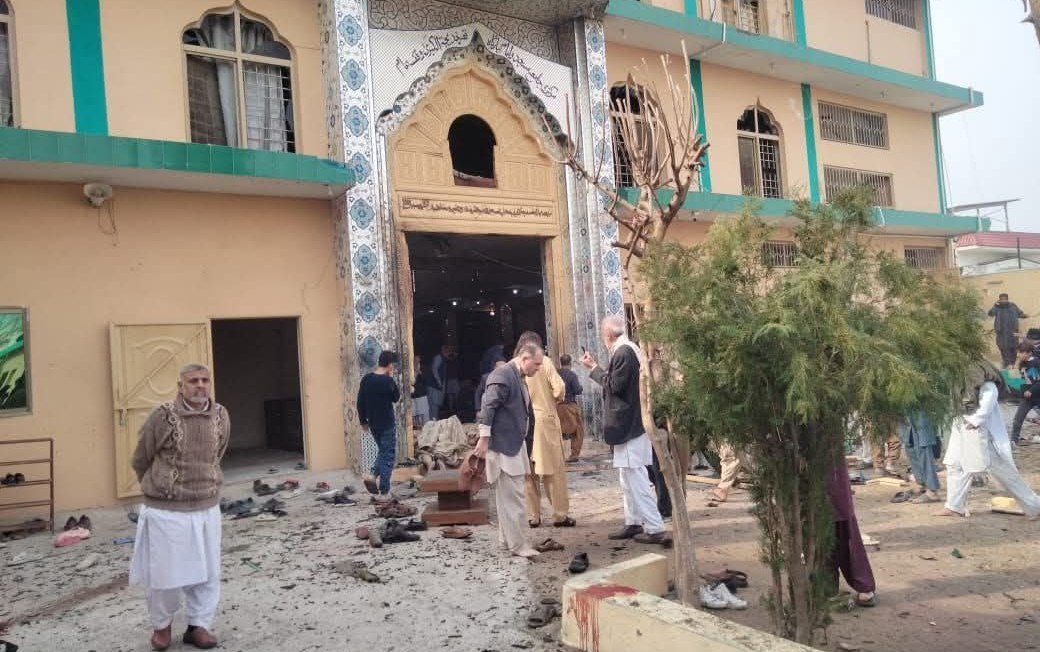
ISLAMABAD: A suicide bomber detonated explosives inside a Shia mosque in Pakistan’s capital during Friday prayers on 3 January, killing at least 31 worshippers and wounding more than 170, according to hospital and police officials cited by local media. The blast, claimed by no group so far, struck the mosque in Islamabad’s heavily secured G-6 sector, underscoring the erosion of the state’s ability to protect even its most sensitive locations.
The Geopolitical Reality
Pakistan’s terrorism curve has steepened since 2021: civilian deaths have almost quadrupled from ~150 in FY 2019-20 to an estimated 650 in 2024, while security-force fatalities rose five-fold to 1,200 last year. The Pakistani state attributes the bulk of the violence to the Tehrik-i-Taliban Pakistan (TTP), whose leadership it says operates from Afghan border provinces. Islamabad’s public narrative now links every major urban attack to Afghan soil, preparing domestic opinion for kinetic options beyond routine artillery or air raids. Western diplomats note, without corroboration, that U.S. interlocutors have hinted at the utility of renewed Pakistani pressure on the Afghan Taliban—pressure that could, in theory, reopen access to the vast Bagram air-base complex 40 km north-east of Kabul. The Taliban’s spokesman has already accused Pakistan of "simultaneously bombing Afghan territory, violating Afghan sovereignty, and undermining peace efforts" to create space for a U.S. military re-entry. No independent evidence supports that claim, but the allegation itself illustrates how quickly regional fault-lines can widen once kinetic thresholds are crossed.
The View from Delhi
India is not a direct actor in this episode, yet three second-order effects matter for New Delhi. First, any large-scale Pakistani ground incursion into Afghanistan would tie down Pakistan Army formations away from the eastern border, altering India’s military calculation ratios along the Line of Control and the international boundary. Second, a sustained cross-border campaign would deepen the Taliban regime’s dependence on its only remaining patron—Pakistan—reducing whatever minimal leverage India still retains inside Afghanistan through humanitarian projects. Finally, a spike in regional violence raises the probability of militant relocation: anti-India groups such as Jaish-e-Mohammed or Lashkar-e-Taiba could exploit the chaos to re-position cadres closer to the Durand Line, complicating India’s counter-terrorism matrix without offering an obvious counter-move. Delhi therefore has a quiet interest in discouraging full-scale escalation while quietly reinforcing intelligence cooperation with Iran and Central Asian states that share its concern over TTP spill-over.
Strategic Implications
Islamabad’s political elite faces a binary: absorb rising domestic casualties and risk appearing impotent, or escalate into Afghanistan and risk a two-front insurgency that stretches finances already under IMF scrutiny. The mosque bombing accelerates the timetable for that decision; Pakistan’s army chief has publicly hinted at "a massive operation" if provocations persist. Yet the Afghan Taliban’s own legitimacy rests on repelling external forces; any Pakistani ground action would invite tribal mobilisation and potentially fracture the Taliban’s internal cohesion. For external powers, the key uncertainty is whether rhetoric translates into a limited border sweep or a larger, U.S.-sanctioned effort to re-open Bagram. Either path raises the baseline threat of retaliatory strikes inside Pakistani cities, prolonging the terrorism cycle that the original operation was meant to break. India’s room for manoeuvre remains narrow: it can monitor, warn, and prepare, but cannot shape the core Pakistan–Afghanistan dynamic without risking over-extension.