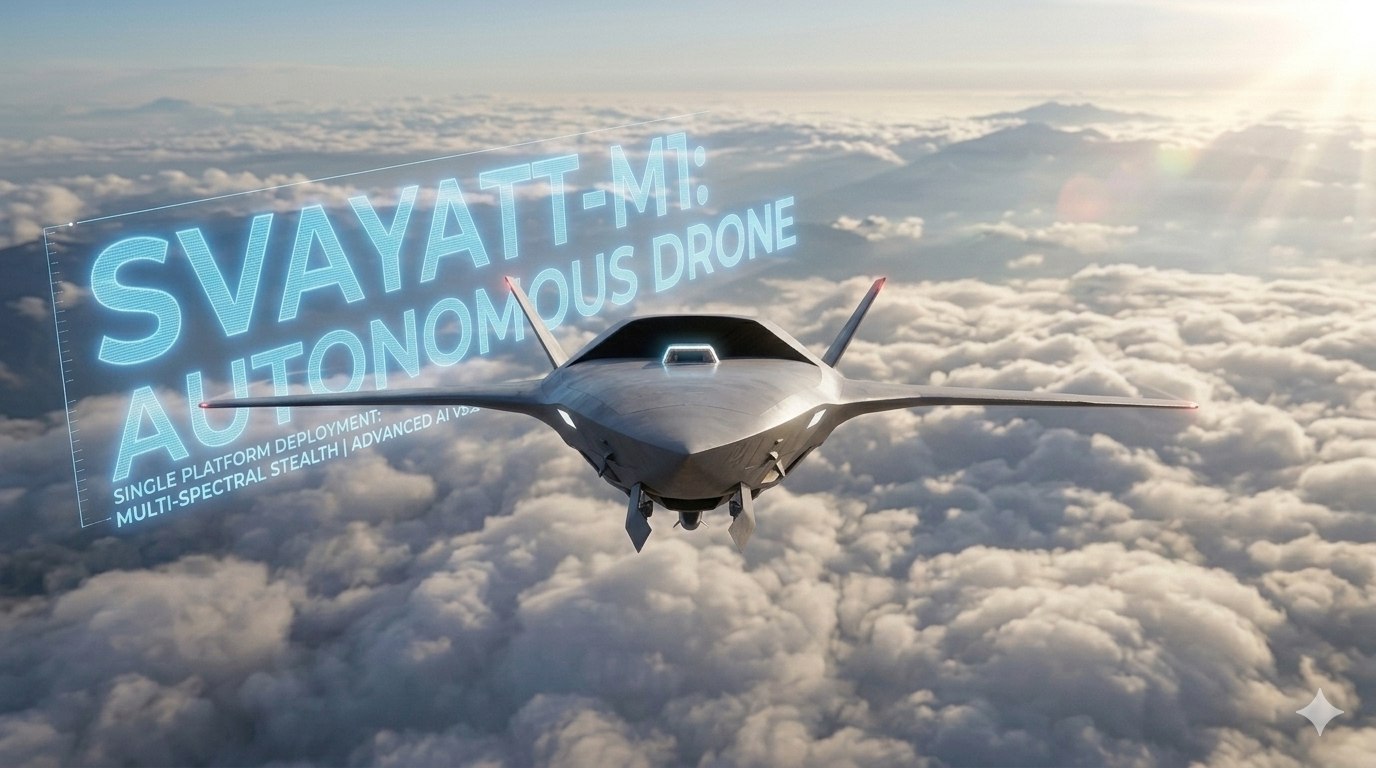
NEW DELHI: The Indian Air Force is flight-testing two indigenous unmanned platforms that together mark a doctrinal pivot toward distributed, AI-enabled air combat: the Swati M1 loyal wingman drone and the DRDO Ghatak stealth unmanned combat aerial vehicle (UCAV). Both systems are designed to operate alongside manned fighters, expanding strike reach while keeping pilots outside the densest air-defence bubbles.
The Geopolitical Reality
Major air forces are converging on the same operational logic: modern surface-to-air missiles now out-range the stand-off weapons of 4th-generation fighters. The US Skyborg, Australia’s MQ-28 Ghost Bat, China’s FH-97A and the Franco-German FCAS “remote carriers” all aim to dilute this cost-exchange ratio by substituting attritable drones for crewed aircraft.
Within this global race, export controls on high-end UAVs remain tight; armed drones are still MTCR Category I items. Indigenous development therefore doubles as a hedge against sanctions and as a potential export lever to smaller Asian states that cannot build loyal wingmen themselves.
The View from Delhi
For India, the loyal-wingman concept is not a luxury procurement—it is a force-structure necessity. Two nuclear-armed adversaries field layered integrated air defence systems (IADS) across the Tibetan Plateau and the Punjab-Rajasthan corridor. Penetrating these belts with legacy Tejas or Su-30MKI packages would entail unsustainable attrition.
Swati M1’s advertised capabilities—autonomous threat re-routing, encrypted mesh networking, modular 350 kg payload bay—directly address this gap. If fielded, a single Tejas could theoretically command 3-4 such drones forward, turning a four-ship mission into a 12-asset strike complex without increasing cockpit risk.
Ghatak’s flying-wing carbon-composite airframe and internal bay serve a complementary purpose: deep, first-night suppression of HQ-9 / S-300 nodes on the Tibetan plateau. An indigenous engine derivative of Kaveri would also end India’s dependence on foreign propulsion for high-altitude UCAVs—an insurance policy against future technology-denial regimes.
Strategic Implications
- Escalation Discipline: Autonomous deep-strike drones compress the sensor-to-shooter loop, raising the probability of inadvertent escalation along a live LAC.
- Cost-exchange Ratios: A Ghatak unit costing ~US $40 million that can neutralise a $200 million S-300 battery rewrites the arithmetic of both punitive and defensive air campaigns.
- Manpower Paradox: The same technologies that allow other militaries to downsize will likely expand India’s order-of-battle; guarding 3,500 km of mountainous border still requires flesh-and-blood presence, with drones acting as multipliers rather than replacements.
- Integration Bottlenecks: Realising distributed air combat hinges on secure, low-probability-of-intercept data-links—an area where India’s defence electronics base remains under-developed relative to platforms.
“The future of air combat may not depend on how many fighters a country possesses. It may depend on how effectively those fighters operate alongside autonomous drones.”
— IAF doctrinal assessment
Whether Swati M1 and Ghatak mature into operationally proven systems or remain technology demonstrators will determine if the IAF can shift from platform-centric to network-centric air warfare—a transition no regional competitor has yet fully accomplished.