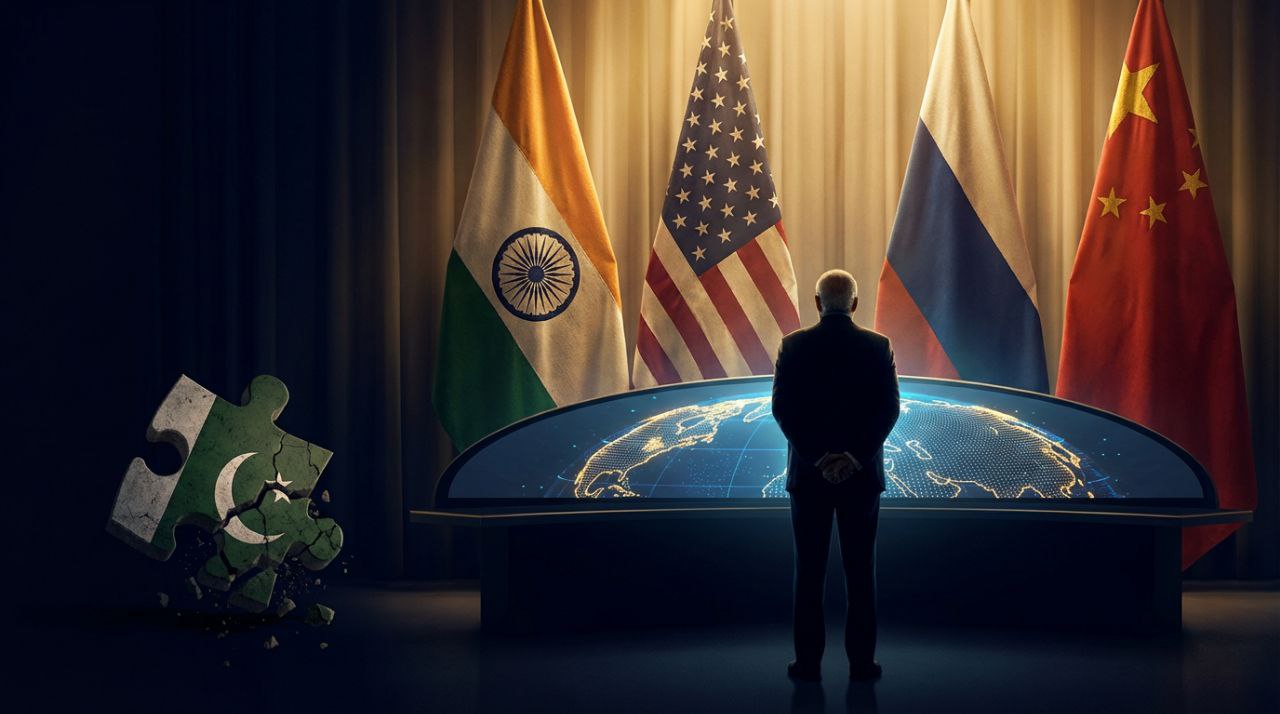
CITY: Washington-based Global Firepower has released its 2026 Military Strength Rankings, placing the United States first, Russia second and China third for the fourth consecutive year. India remains fourth, while Pakistan fell from seventh in 2023 to fourteenth. Israel rose to fifteenth, overtaking Iran for the first time. Indonesia entered the top-20 at nineteenth, ahead of European powers Germany and Italy.
The Geopolitical Reality
Global Firepower’s composite index—tracking manpower, airpower, naval assets, logistical depth, financial health and geography—continues to favour the established nuclear-armed heavyweights. Washington’s top ranking rests less on raw numbers than on global basing, power-projection fleets and R&D spending that exceeds the next nine defence budgets combined. Moscow retains second place despite battlefield attrition in Ukraine, aided by legacy stockpiles, theatre-range missiles and maintained nuclear parity. Beijing’s third-place score reflects the world’s largest standing navy and a defence budget that has tripled since 2010, yet the index penalises China for limited basing abroad and—new in this edition—continued purges inside the Central Military Commission, interpreted as institutional risk.
The middle tier is in flux. Pakistan’s seven-place drop is the largest year-on-year slide recorded since 2015 and follows the loss of several Chinese-supplied air-defence batteries during Operation Sindoor. Islamabad’s procurement pipeline remains open—nuclear delivery systems stay on track—but the index’s methodology weights current deployable inventory, cutting its score. Conversely, Israel’s incremental rise stems from sustained US resupply, indigenous missile-defence maturation and combat-proven ISR integration. Tehran, constrained by arms embargoes and ageing Western platforms, slipped two places to sixteenth.
Indonesia’s ascent into the top-20, without nuclear weapons, underscores how regional defence accords and diversified procurement can outrank bigger budgets. Jakarta’s acquisitions include 42 Dassault Rafale fighters and, reportedly, a US$450 million BrahMos coastal battery from India. Saudi Arabia’s slide to twenty-fifth—lowest since the index began—mirrors coalition doubts about the Kingdom’s capacity to absorb high-end systems without US enablers.
The View from Delhi
For Indian planners, the static top-four masks two structural warnings. First, the gap between China and India in aggregate points has widened for the fifth straight year, driven largely by Beijing’s 6:1 advantage in annual defence outlays and a 3:1 lead in dedicated R&D expenditure. New Delhi allocates roughly five per cent of its smaller budget to research; Washington and Beijing spend 10–15 per cent of already larger totals. Absent a higher defence spend, the index suggests India risks plateauing while the People’s Liberation Army continues modernisation.
Second, the emergence of Indonesia as a capable maritime neighbour injects uncertainty into the eastern Indian Ocean. A US$450 million BrahMos sale will tighten bilateral industrial links, yet Jakarta’s simultaneous overtures to Islamabad for JF-17 Thunder aircraft signal hedging behaviour typical of middle powers. From Delhi’s perspective, the strategic premium lies in ensuring Indonesian acquisitions remain transactional, not ideological, should domestic politics in Jakarta shift.
Pakistan’s slide is tactically welcome but strategically ambiguous. Rawalpindi’s nuclear threshold remains unchanged, and the Pakistan Army can still mass along the International Border faster than Indian forces can mobilise reserves. The index captures equipment holdings, not escalation calculus; therefore, the deterrence balance in South Asia is unaltered even as Pakistan’s conventional score deteriorates.
Strategic Implications
The rankings reinforce that qualitative metrics—networked sensors, precision munitions, sustainment depth—now outweigh raw platform counts. For India, closing the R&D gap is time-critical: every year Beijing fields new hulls, hypersonics and satellite constellations while Delhi’s modernisation cycles stretch to 15–20 years. Raising the defence budget to two per cent of GDP is necessary but insufficient; unless the R&D share doubles, India risks permanent asymmetry with China and growing dependence on emergency imports during crises.
Regionally, Indonesia’s trajectory illustrates how middle powers can leapfrog without nuclear arms, relying instead on alliance fungibility and tailored deterrence. Delhi must decide whether to deepen defence-industrial ties—co-production, not merely sales—to lock Jakarta into an Indian-aligned security web, or risk Jakarta playing Beijing and Islamabad for leverage. The BrahMos sale is a first step; co-development of sensors, MRO hubs and intelligence fusion would raise switching costs for Indonesian decision-makers.
Finally, the index’s stability at the top conceals a looming vacuum: New START expires in 2026 with no successor treaty. Without legal caps, US and Russian deployed warheads could rise for the first time since 2010. For India, an unconstrained US-Russia dyad complicates future arms-control diplomacy: Washington may press Delhi for FMCT adherence while Moscow, economically reliant on Beijing, could acquiesce to Chinese multilateral forums that disadvantage India. Managing this diplomatic tightrope will require aligning with middle-power coalitions—Japan, Australia, France—rather than solo balancing, a shift the index’s hard numbers do not capture but which will shape the next decade of strategic choices.