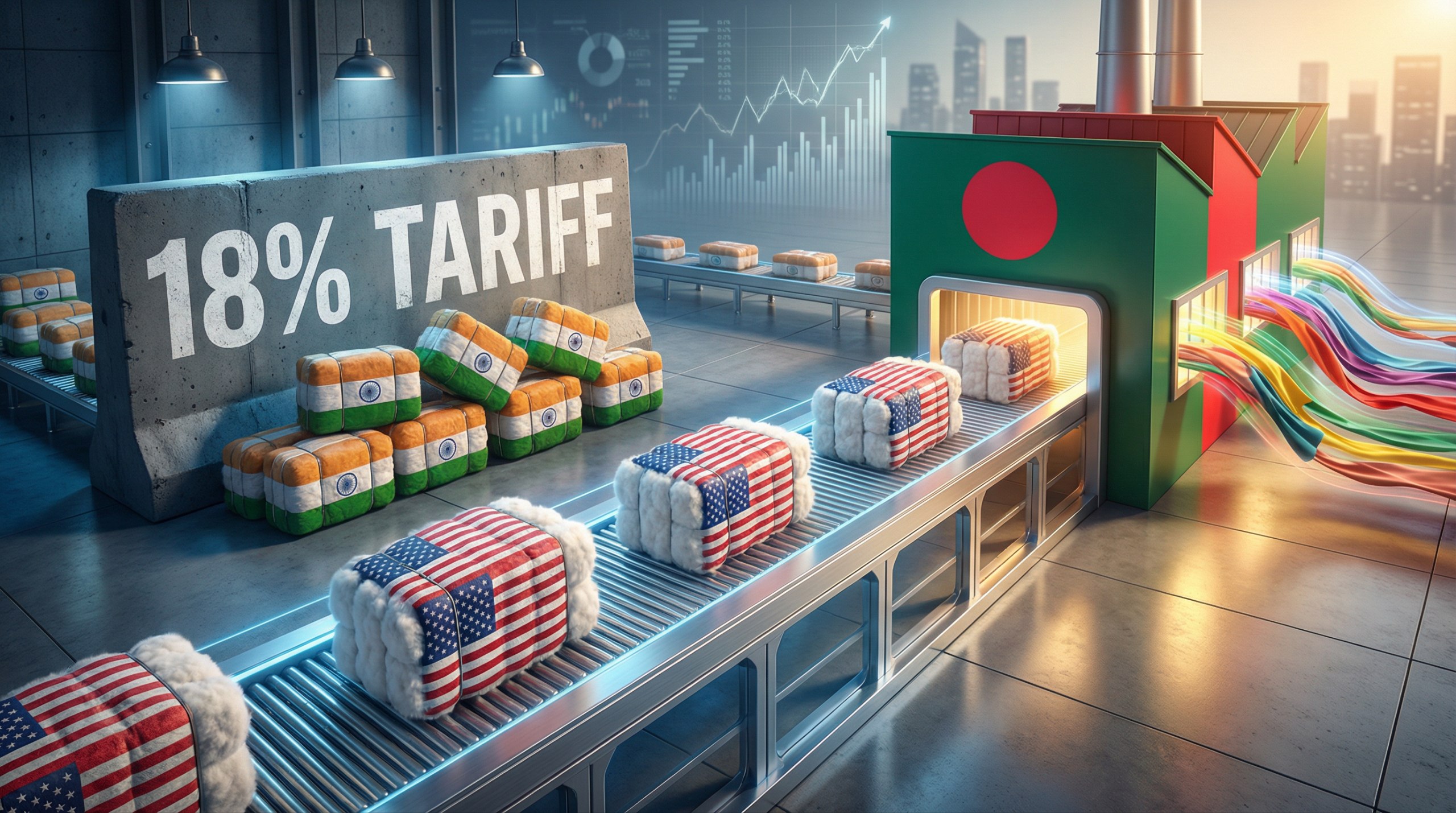
Washington: The United States and Bangladesh concluded an interim trade understanding on 8 March that grants zero-tariff entry to specified Bangladeshi textile shipments into the US market provided Dhaka purchases US-grown cotton and opens wider market access for American agricultural and digital services.
The Geopolitical Reality
Washington’s move exploits two structural facts: Bangladesh is the world’s second-largest ready-made garment exporter after China, and US imports of cotton and wheat need new buyers after India restricted some American farm goods. By tying duty-free access to cotton-of-origin clauses, the US simultaneously supports its domestic growers and positions Bangladesh as a tariff-free platform for US-bound apparel.
"Bangladesh commits to permit free transfer of data… purchases of US$ 3.5 billion of US agricultural products."
— White House fact sheet, 8 Mar 2025
The arrangement is narrow. Only cotton-based garments manufactured from US fibre qualify, capping the volume through country-of-origin certificates. Nevertheless, the deal gives Dhaka a competitive 18-percentage-point margin over Indian garments that still face the US Most-Favoured-Nation rate of 18%.
The View from Delhi
For Indian strategists, the accord highlights two vulnerabilities. First, the textile sector—India’s second-largest employer—remains outside the limited duty concessions New Delhi has so far secured from Washington. Second, Washington is willing to weaponise market access to realign supply chains away from India when geopolitical incentives align.
India’s own interim trade framework with the US, still under negotiation, covers silk exports but leaves cotton-based apparel at full tariff. Because silk accounts for a fraction of India’s US-bound textile earnings, the concession is symbolic rather than material.
Strategic Implications
The episode underlines that future US market access will hinge on commodity linkage: countries that buy American cotton, wheat or energy will receive tariff relief. New Delhi’s longstanding refusal to drop data-localisation demands or lower farm-product restrictions limits its bargaining space.
Over a five-year horizon, Washington could replicate the template with Vietnam, Indonesia or East African states, progressively eroding India’s export competitiveness in labour-intensive sectors. India therefore faces a policy triad:
- Tariff Leverage: Accept selective agricultural imports to secure textile concessions, risking domestic political backlash.
- Supply-Chain Diplomacy: Accelerate fibre-yarn backward integration to dilute the US cotton clause elsewhere.
- Market Diversification: Deepen EU and Indo-Pacific textile access to offset potential US share loss.
Finally, the data-transfer waiver granted by Dhaka raises the cost of India’s insistence on data localisation as a non-negotiable pillar of strategic autonomy. American firms now have a compliant, low-tariff hub in Bangladesh for cloud, fintech and e-commerce operations serving South Asia—an option Washington could expand to other neighbours should India hold its line.