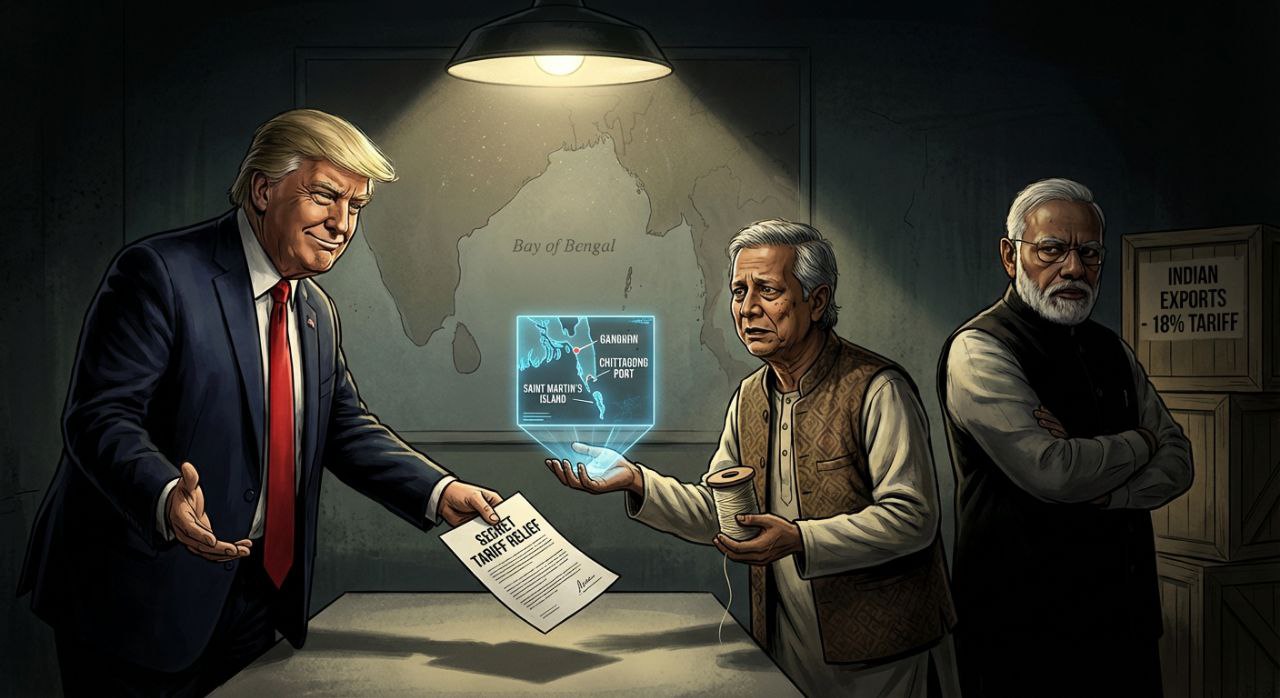
WASHINGTON: Bangladesh has quietly approached the United States for a bilateral textile arrangement that would lower effective tariffs below the published 20% rate, Bangladeshi outlets say, after learning that India is poised to pay only 18% on a broad range of goods once the long-negotiated India–US trade package is signed. Details of the India deal are scheduled for release in March 2026; Dhaka fears that a 2-percentage-point disadvantage could divert bulk orders of ready-made garments to Indian suppliers already expanding woven and knit capacity.
The Geopolitical Reality
Global garment trade is hypersensitive to marginal tariff shifts: a single percentage point can move sourcing contracts worth hundreds of millions of dollars. China dominates with 32% of world textile/clothing exports but is slowly ceding share to lower-cost hubs. Bangladesh has climbed to second place, relying on garments for roughly 85% of its merchandise exports and about 11% of national GDP. Vietnam, Germany, Italy and, more recently, India follow in the league tables. Washington’s publicly applied rates—20% on most Bangladeshi apparel, 18% on equivalent Indian lines once the new agreement enters into force—therefore translate directly into relative market share and, for Dhaka, into foreign-exchange earnings that service its external debt and keep the taka stable.
The View from Delhi
For Indian strategists, the episode underscores two structural facts. First, tariff parity inside the US market removes a long-standing Bangladeshi advantage, offering domestic producers a realistic shot at clawing back mid-priced garment orders they had ceded over the past decade. Second, any clandestine side letters between Washington and Dhaka would confirm a pattern—seen in defence cooperation statements since 2023—of growing US security interest in India’s eastern neighbour. New Delhi will calculate that lower US tariffs on Bangladeshi textiles could blunt India’s price competitiveness, but also that India’s wider export basket (pharma, engineering goods, IT services) cushions the macro-impact more than Bangladesh’s garment-dependent economy. The bigger question is geopolitical: whether opaque trade sweeteners become leverage for deeper US military access to the Bay of Bengal littoral, complicating India’s own neighbourhood posture.
Strategic Implications
1. Competitive squeeze: If Dhaka secures an unpublished tariff rebate, Indian exporters face a playing field that looks level on paper but is tilted in practice; New Delhi would have to decide whether to press US counterparts for transparency or to match any non-tariff concessions Washington may demand from Bangladesh.
2. Rules-setting precedent: A two-track tariff regime—public MFN rates versus confidential offsets—would weaken the credibility of the US schedule across the Global South, giving other developing exporters a rationale to seek side deals and eroding the multilateral tariff architecture India supports.
3. Security externalities: Bangladesh’s limited market size means any quid pro quo is unlikely to be commercial; Washington’s likely asks centre on defence logistics or intelligence cooperation. India will monitor basing chatter, port access agreements and joint exercises for signs that trade concessions are the entry fee for a larger US footprint astride India’s eastern seaboard.
4. Supply-chain diversification: American retailers, already hedging against China-plus-one risk, could split orders between India and Bangladesh even if effective tariffs converge. Indian firms able to offer man-made fibre garments—where Bangladeshi capacity is thinner—may still gain share, but only if domestic logistics and labour productivity bottlenecks are resolved.
5. Domestic politics in Dhaka: The interim government lacks an electoral mandate; a secret deal, if exposed, could galvanise nationalist factions and open space for external actors to influence Bangladesh’s alignment. Instability in the northeast neighbourhood remains a latent risk for India’s border management and coastal security.