
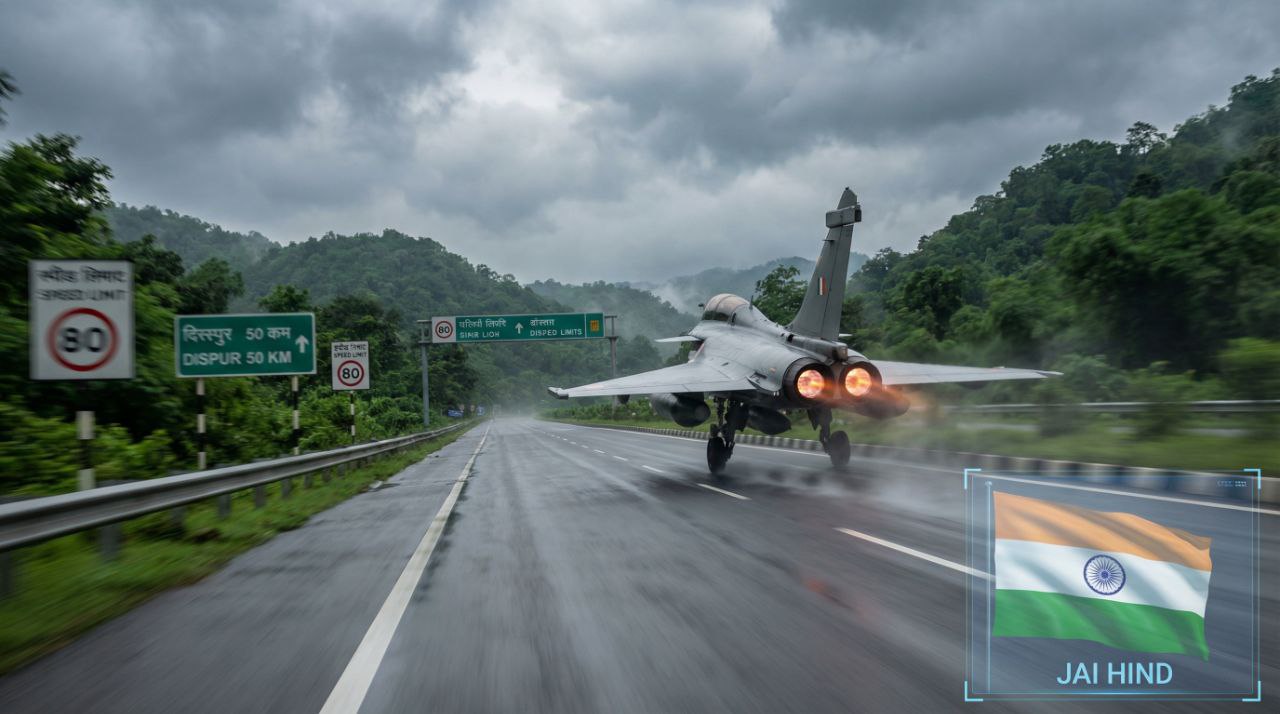
Moran, Assam: Prime Minister Narendra Modi on 11 October touched down in a C-130 Hercules on the newly-converted 4.2 km Emergency Landing Facility (ELF) here, formally declaring the country’s first operational highway airstrip in the North-East.
- Length: 4.2 km of NH-15 upgraded with reinforced concrete and arrestor-beds.
- Cost: ≈ ₹100 crore; executed by NHAI under MoRTH.
- Capable of: C-130, C-17, Su-30MKI, Rafale and Chinook ops.
- Part of: Plan for 28 such strips nationwide, five to be in Assam alone.
An accompanying fly-past by Su-30s, Rafales and Dhruv helicopters demonstrated rapid turn-round drills. Road traffic will resume under a flip-flop lane system once the strip is not activated.
The Geopolitical Reality
Highway airstrips are dual-use infrastructure pioneered by Sweden during the Cold War and replicated by China on the Tibetan plateau since 2014. Beijing’s network allows the PLA Air Force to disperse fighters away from fixed bases, complicating Indian counter-air targeting.
"Highway strips can serve as alternative airports in case military airports are destroyed."
— Global Times, 2014
New Delhi’s late—but accelerated—roll-out is concentrated on the eastern seaboard: 11 of the 28 approved ELFs lie in Assam, West Bengal and Bihar, underscoring where planners assess the highest risk of first-wave missile strikes.
The View from Delhi
For Indian strategists, the Assam strip is less a deterrent than a resilience tool. By embedding redundant runways inside civilian road grids, the air force complicates Chinese targeteering without pouring concrete on new airbases that would invite diplomatic opprobrium and budget strain.
The ELF also mitigates the tyranny of terrain: the North-East hosts only a handful of full-spectrum airfields. If a saturation attack on main bases like Tezpur, Chabua or Hasimara knocks out runways, IAF fighters can stage forward from four more Assam highway segments, preserving sortie generation.
Strategic Implications
Completion timelines will decide utility. China already has at least eight operational highway strips opposite Arunachal Pradesh; India’s first became live a decade later. Faster build-out of the remaining 27 approved ELFs—and proof that rapid conversion drills work under fire—will determine whether the initiative amounts to more than optics.
Second, the highway model scales only if supporting assets—fuel bladders, ordnance caches, mobile radars—are pre-positioned. Without them, landing is possible; re-arming and launching is not.
Finally, dispersal cuts both ways. Pakistan, having lost hardened shelters in Operation Sindoor, may now seek similar redundancy. Expect Islamabad to float highway-strip proposals within the next three-five years, adding another layer to India’s western air-defence calculations.