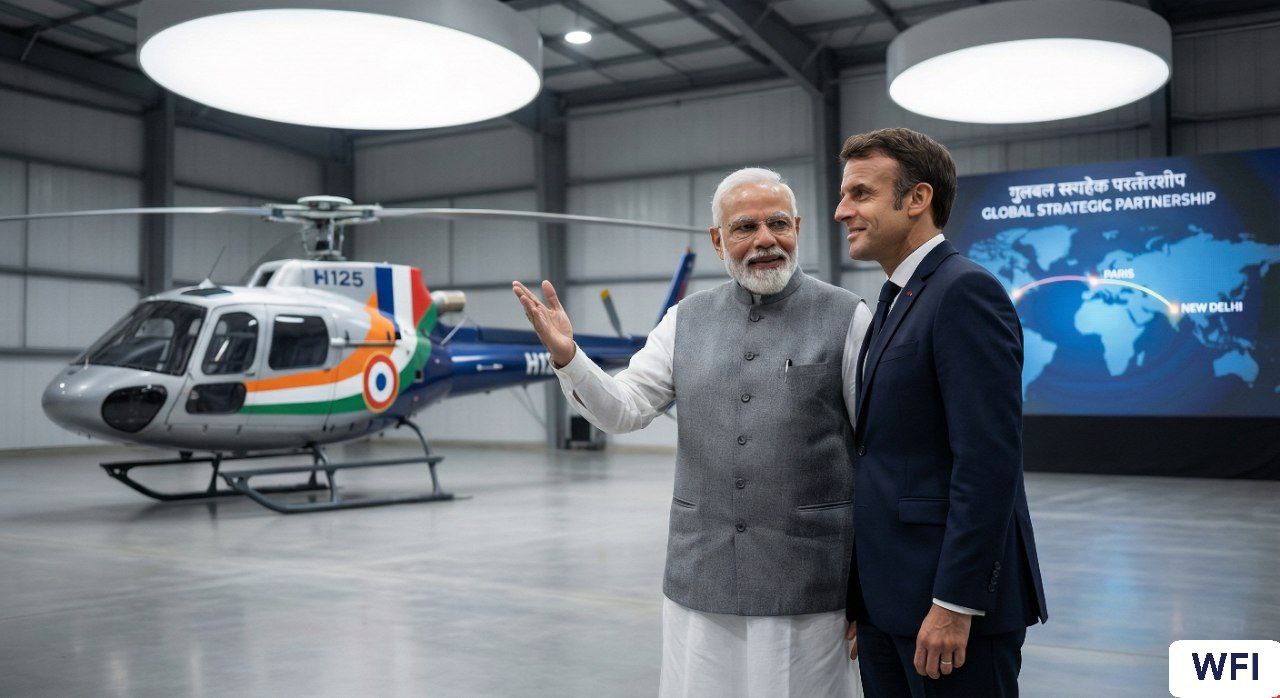
BENGALURU: Airbus Helicopters and Tata Advanced Systems Limited (TASL) have formally opened the final assembly line for the H125 light utility helicopter at the company’s facility in Karnataka. Prime Minister Narendra Modi and French President Emmanuel Macron conducted the virtual ribbon-cutting on 10 February, signalling that series production for domestic and export customers can now begin.
The Geopolitical Reality
Until today, no European aerospace major had transferred a complete rotary-wing production line to India. The move places France ahead of Germany, the United Kingdom and Italy in embedding military-industrial capacity inside the Indian economy.
The H125 is the same platform a French Air Force pilot landed on Mount Everest in 2005, an altitude record still unbroken. Airbus will now build the airframe, integrate Indian and French avionics, and re-export finished machines to third countries—an arrangement New Delhi has long sought but rarely obtained from Western suppliers.
- Capacity: 50–60 helicopters per year at full rate.
- Local content target: 40 % by value within three years.
- Export clearance: France has waived re-export licences for 25 countries, including India’s traditional defence customers in South and South-East Asia.
“This helicopter, which can land on the roof of the world, will now be made in India and sent across the globe.”
— Prime Minister Narendra Modi
Washington and Moscow still dominate Indian defence imports, but Paris has become the most agile Western supplier: 36 Rafale fighters, Scorpene submarines, MICA air-to-air missiles and now the H125 final assembly line have all been cleared in the last decade.
The View from Delhi
For Indian planners, the helicopter line is less about rotorcraft and more about precedent. France has accepted Indian quality-assurance standards, agreed to a royalty-free technology package for the export market, and—crucially—placed no end-use monitoring conditions on third-party sales. That template, if replicated, could accelerate the Make-in-India push across heavier defence platforms.
The strategic dividend is diplomatic: France becomes the third country after Japan and the United States to be tagged as a “global” strategic partner, a designation that signals coordination beyond bilateral issues. Delhi gains a veto-empowered friend inside the P-5 and a back channel into the European Union’s technology control regimes.
Strategic Implications
Success will be measured by export orders, not domestic ones. If Tata-Airbus can undercut Airbus’ own European line on price while maintaining European certification, India could capture a slice of the 3,000-unit global light-helicopter replacement market over the next decade. Failure would reinforce the view that India can assemble but not competitively sell advanced defence hardware.
Two risks follow. First, technology absorption: the H125’s Safran Arriel 2D engine and Airbus’ proprietary composite blades are still imported. Without a domestic engine option, India remains at the mercy of French export licences. Second, geopolitical signalling: Russia—still India’s largest arms vendor—has watched Western partners deepen defence ties without similar concessions. Whether Moscow responds with co-development offers or stiffer pricing on spares will shape India’s next procurement cycle.